


By Mark Lowe
Marketing strategy gives your company direction.
Marketing operations makes that direction executable.
It connects the decisions behind your marketing to the systems, processes, data, ownership, and measurement required to carry them out consistently. Without that operating discipline, even a thoughtful strategy can become a collection of disconnected campaigns, tools, reports, and handoffs.
This is why marketing can feel scattered even when your team is working hard. The issue is often structural, not personal.
A stronger marketing operations strategy creates a clearer path from planning to execution, from customer interaction to usable data, and from activity to measurable improvement.
What marketing operations actually means
Marketing operations is the discipline of designing and managing how marketing work gets done.
That includes:
- Translating business goals into marketing priorities.
- Defining repeatable processes and customer lifecycle stages.
- Connecting websites, funnels, CRM platforms, automation, analytics, and other tools.
- Establishing data standards and ownership.
- Measuring performance against meaningful outcomes.
- Improving the system as new information becomes available.
It is broader than software administration.
A platform may be configured correctly and still fail to support the business. A CRM may contain thousands of contacts and still provide little clarity. An automation may run as designed while sending the wrong message at the wrong point in the customer journey.
Marketing operations creates the structure around the technology.
The need is becoming more visible as stacks become more complex. The CMO Council’s 2026 operational-state findings report that only one in four participating chief marketers consider their organizations highly advanced, adaptable, and agile with emerging martech. The same report identifies fragmented systems, disconnected workflows, and limited alignment as ongoing challenges.
More tools do not automatically create better operations.
Clearer connections do.
Strategy and operations. Different roles, one direction.
Marketing strategy answers questions such as:
- Who are you trying to reach?
- What problem do you solve?
- How should your offer be positioned?
- Which channels and customer journeys matter?
- What does growth need to look like?
Marketing operations answers a different set of questions:
- How will the strategy be executed?
- Which systems support each stage?
- Who owns each decision and handoff?
- What data needs to be captured?
- How will performance be measured?
- What happens when something changes or fails?
Strategy sets the destination.
Operations creates the route, the controls, and the feedback loops that help you get there.
When the two are separated, a business may have strong ideas without reliable execution. When they work together, marketing becomes easier to manage, easier to measure, and more capable of improving over time.
The six operating layers
A useful marketing operations framework includes six connected layers.

1. Strategy translation
Begin with business priorities, not tools.
Translate broad goals such as growth, retention, market expansion, or stronger visibility into specific marketing objectives. Then define the activities, audiences, offers, and customer journeys that support them.
A strategy is not operational until people can understand what to do next.
2. Process design
Document how work moves from idea to execution.
This may include campaign intake, content approvals, lead routing, sales handoff, customer follow-up, reporting, and issue resolution. The goal is not to create unnecessary bureaucracy. It is to reduce repeated questions, delays, and avoidable errors.
Your marketing handoff process should make ownership clear at every important transition.
3. Technology and systems
Your systems should support the customer journey rather than dictate it.
This may include your website, landing pages, forms, CRM, email platform, analytics tools, automation, scheduling software, and reporting environment. Each tool should have a defined purpose and a clear relationship with the rest of the system.
A connected marketing system is more useful than a large collection of isolated platforms.
The CMO Survey’s martech research found that respondents used only 56.4% of the marketing technology tools their organizations had purchased. That gap is a reminder to improve adoption, integration, and usefulness before adding another platform.
4. Data and governance
Data needs definitions, standards, and ownership.
Decide how you will define a lead, opportunity, customer, source, campaign, lifecycle stage, and conversion. Establish who can create fields, change automations, edit records, approve tracking conventions, and resolve data-quality issues.
Governance should be practical. It should protect accuracy and privacy without making everyday execution unnecessarily slow.
5. Measurement and attribution
A healthy operation connects activity to decisions.
Start with a small set of useful measures. Depending on your business, these may include qualified inquiries, conversion rates, sales velocity, pipeline contribution, customer acquisition cost, retention, or revenue.
Do not confuse available data with useful measurement. The 2026 Supermetrics Marketing Data Report reports that 40% of surveyed marketers struggle to prove ROI across channels, while 36% identify marketing data connection as an area needing improvement.
Better reporting begins with connected definitions and dependable inputs.
6. Optimization
Operations should create a learning loop.
Review what happened. Identify where performance or process quality weakened. Make one focused improvement. Test the change. Document the result.
Optimization may involve a landing page, a follow-up sequence, a lifecycle definition, a dashboard, a handoff, or a campaign approval step.
Small improvements accumulate.
Common failure modes
Tool-first buying
A new platform is purchased before the business defines the problem it needs to solve.
Better approach: define the use case, owner, required data, expected outcome, and integration requirements first.
Disconnected systems
The website, CRM, automation, analytics, and sales process each contain part of the customer story.
Better approach: map how information should move from first interaction through conversion and follow-up. Your marketing infrastructure should support that movement.
Unclear ownership
Everyone assumes someone else is responsible for data quality, lead routing, reporting, or automation changes.
Better approach: assign one accountable owner for every critical process, even when several people contribute.
Missing lifecycle definitions
Teams use terms such as “lead,” “qualified lead,” and “customer” differently.
Better approach: define each stage, the criteria for entering it, the required action, and the person or team responsible for the next step.
Vanity reporting
Reports emphasize traffic, impressions, open rates, or activity without showing what those signals mean for the business.
Better approach: connect channel metrics to customer movement, pipeline, conversion, and revenue wherever the data supports it.
Automation without quality assurance
A workflow is launched and assumed to be correct indefinitely.
Better approach: test every important automation before launch, review it regularly, and create safeguards for missing data, duplicate contacts, incorrect routing, and unusual behavior.
A practical 90-day improvement framework
You do not need to rebuild everything at once.
Days 1–30: Assess and clarify
Create a current-state map.
Review:
- Business goals and marketing priorities.
- Existing tools and integrations.
- Customer journeys and lifecycle stages.
- Campaign and content workflows.
- Lead routing and follow-up.
- Data definitions and quality.
- Current reports and decision-making routines.
Interview the people who use the system every day. They often know where the friction is.
At the end of this phase, identify three to five high-impact issues. Avoid creating a list so long that nothing moves forward.
Days 31–60: Design and repair
Define the desired operating model.
Document:
- Core systems and their roles.
- Ownership and approval points.
- Lifecycle stages and handoff rules.
- Tracking and naming conventions.
- Primary performance measures.
- Required integrations.
- Quality-assurance steps.
Then repair the most valuable connections first. This may mean improving a form-to-CRM workflow, clarifying a funnel, correcting lead routing, or rebuilding a follow-up sequence.
A funnel that converts depends on more than page design. It also depends on what happens after the form is submitted.

Days 61–90: Launch, measure, and improve
Put the revised processes into use.
Create a simple operating rhythm:
- Weekly review of active work and operational issues.
- Monthly review of performance and data quality.
- Quarterly review of systems, priorities, and capacity.
Track operational measures such as time to launch, lead response time, routing accuracy, automation errors, data completeness, and system adoption.
Then connect those measures to business outcomes. Efficiency matters, but the purpose is better marketing performance and a clearer customer experience.
Checklist for a healthy operation
Your marketing operation is moving in the right direction when:
- Strategy is translated into clear priorities.
- Every core process has an owner.
- Lifecycle stages are defined consistently.
- Systems share the information they need.
- Data standards are documented and maintained.
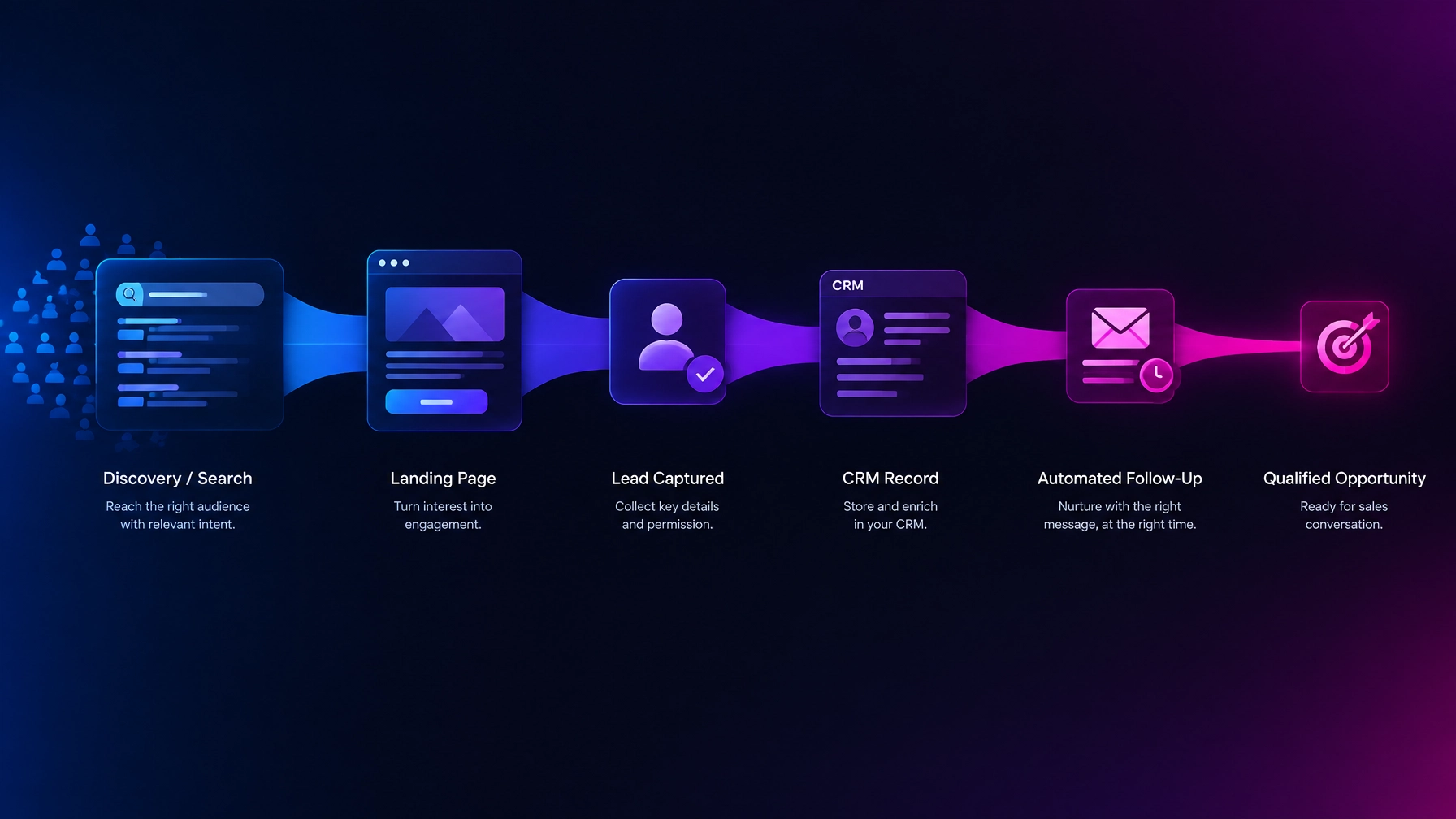
- Forms, funnels, CRM, and follow-up work together.
- Reporting supports decisions rather than filling dashboards.
- Automations are tested and reviewed.
- Sales and marketing understand their handoffs.
- Customer journey gaps are visible.
- Improvements are prioritized and documented.
- Your team can explain what happens next.
This is the practical meaning of a connected B2B customer journey. Each stage should lead naturally to the next, with the right information available to support the customer and the team.
When outside help makes sense
Outside support can be useful when:
- Your systems have grown faster than your processes.
- Reporting cannot be trusted.
- Important leads are delayed or lost between teams.
- Your CRM and automation are underused.
- Your website, funnels, and follow-up feel disconnected.
- Internal teams are too busy to document and improve the operation.
- You need strategic guidance before investing in more technology.
The right partner should not simply add another tool or take over without context. They should help you understand the current system, clarify priorities, strengthen the foundation, and create a practical path forward.
That is the role of an integrated partner like Holly Acre Media. Strategy, search visibility, websites, funnels, content, CRM, automation, and ongoing improvement become more effective when they are planned as one connected system.
Visibility still matters. Your operation should support the way people discover and evaluate your business, including changing search behavior and AI-assisted discovery. The AI search and SEO guide provides additional context on that part of the customer journey.
Build the system behind the strategy
Marketing operations is not a back-office exercise.
It is how your strategy becomes consistent, measurable, and capable of improvement.
Start with direction. Clarify the process. Connect the systems. Govern the data. Measure what matters. Improve the next step.
Less noise. More alignment.
If your marketing feels scattered, send Holly Acre Media a message. A focused review can help identify where the system is creating friction and what to strengthen first.