

By Mark Lowe
A B2B deal rarely begins with a contact form.
It may begin with a search query, a shared article, a recommendation, or a quiet visit to your website. The person may not identify themselves. They may not be ready to speak with sales. They may be trying to understand a problem before they even know which solution they need.
By the time a prospect books a call, much of the decision may already be formed.
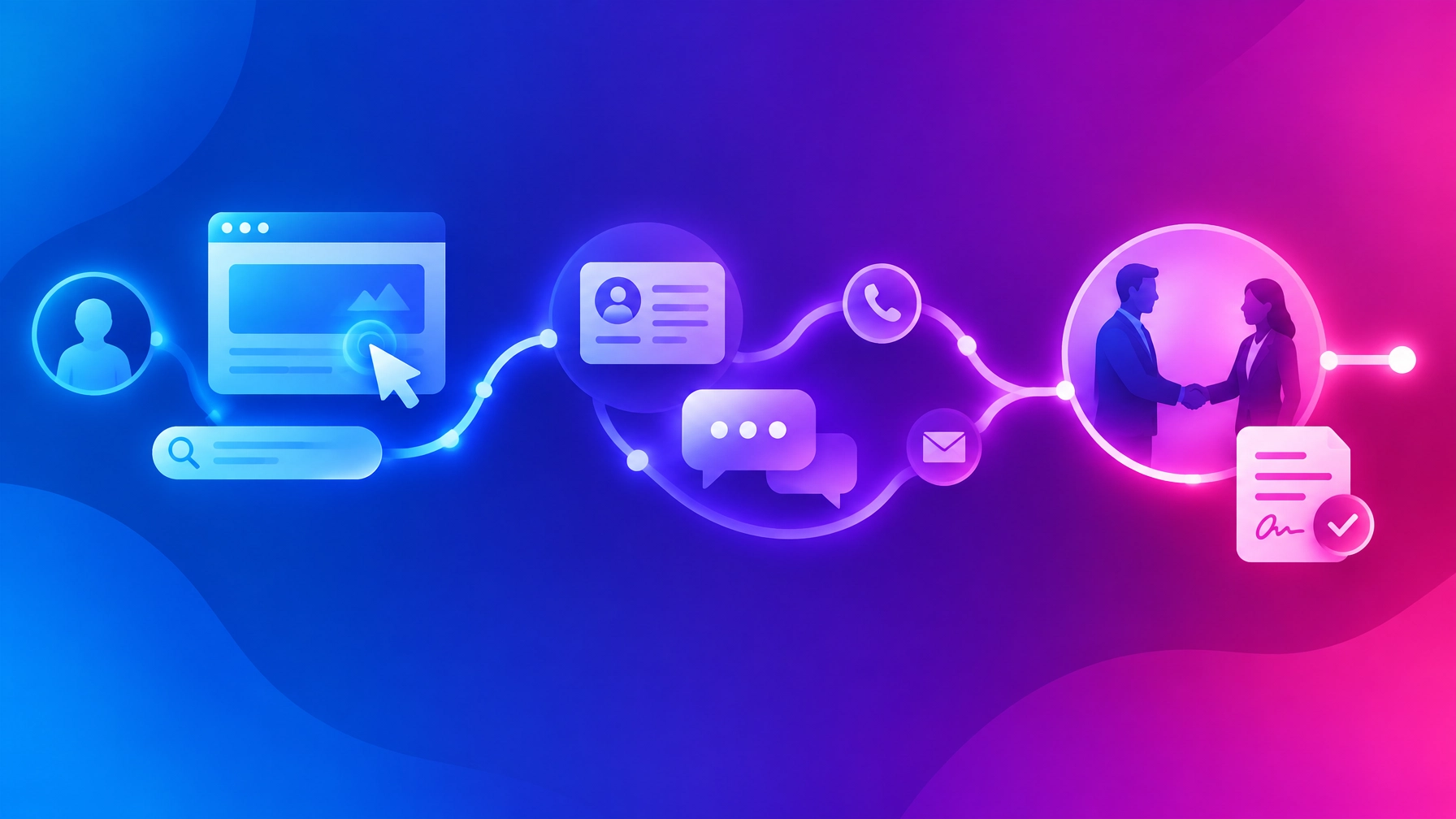
That is why a modern b2b lead generation strategy must account for the full journey, not only the moment a lead enters the CRM. Search, content, website experience, marketing funnels, sales follow-up, and CRM systems all influence the outcome.
The journey is not a simple funnel diagram.
It is a connected system.
The buyer is researching before you know they exist
B2B buyers often complete a substantial portion of their research before contacting a vendor. They search for problems, compare approaches, review providers, ask colleagues, and build internal requirements.
The process may continue for weeks or months.
During that time, your business is being evaluated alongside competitors you may not even know are in consideration. Your website, content, search visibility, reviews, and points of view all contribute to the decision.
A prospect may:
- Search for a solution to a recurring business problem
- Read educational content without submitting a form
- Return to several pages over time
- Share information with colleagues
- Compare vendors before speaking with anyone
- Build an internal business case
- Contact sales only after a shortlist is already established
This invisible phase matters.
If your marketing begins at “demo requested,” you are entering the journey late.
A buying committee, not a single lead
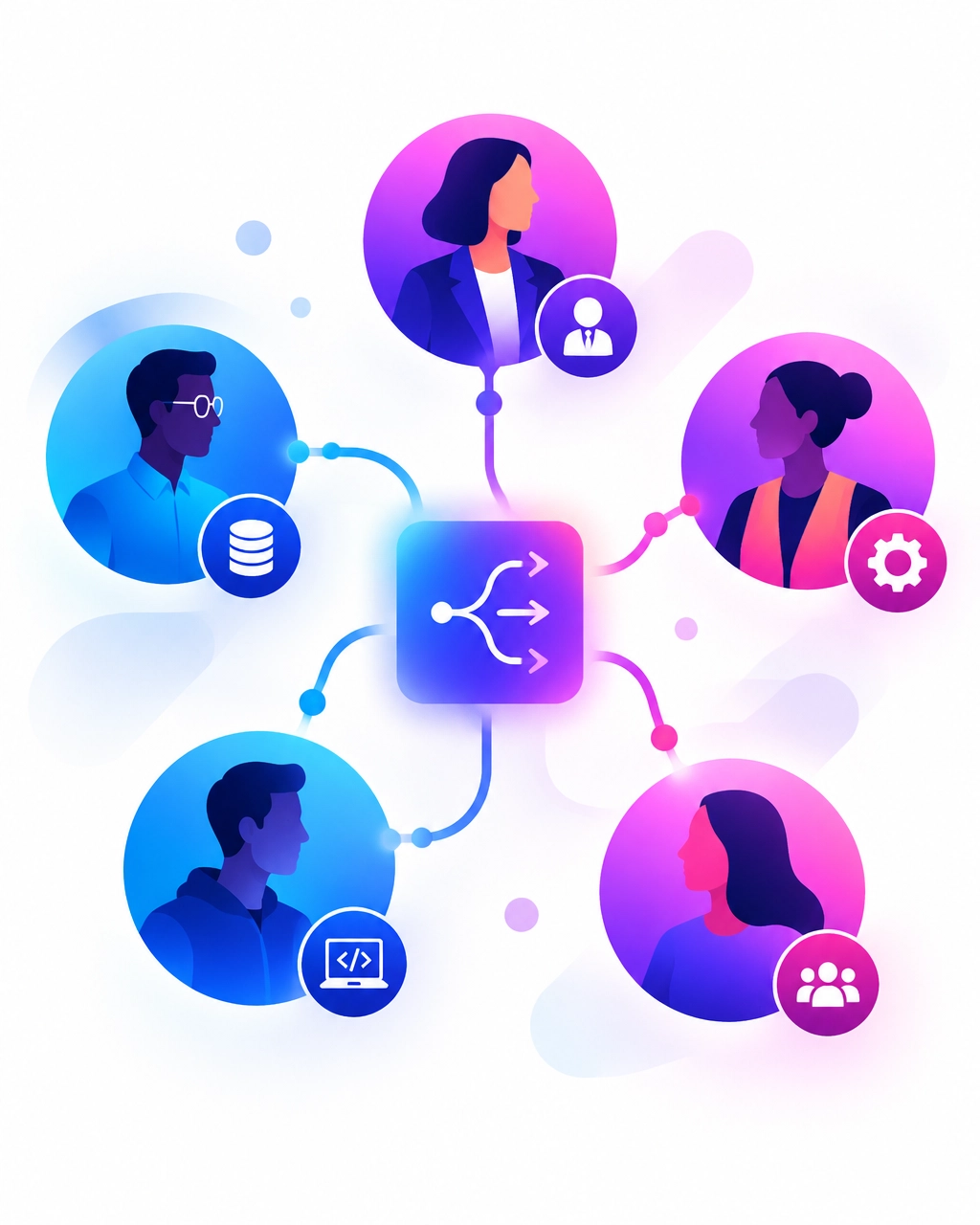
Many B2B purchases involve several people with different priorities.
One person may identify the problem. Another may evaluate technical requirements. Finance may review cost and risk. An executive may approve the investment. End users may influence the final decision based on usability and implementation concerns.
Each stakeholder asks a different question:
- The initiator: Can this solve the problem?
- The technical reviewer: Will it work with our current systems?
- Finance: Is the investment justified?
- The executive sponsor: Will this support our broader goals?
- The end user: Will the change be practical to adopt?
- Procurement or legal: Can we approve the terms and reduce risk?
A single lead record rarely represents the whole buying group.
Your marketing and sales process should make room for multiple stakeholders. That means creating content for different questions, identifying gaps in committee coverage, and giving internal champions material they can share with decision-makers.
The modern B2B journey has overlapping stages
The stages below are useful for planning. They are not rigid steps. Buyers may move backward, skip stages, or revisit the same question several times.
1. Problem recognition
The buyer notices an issue.
Leads are being missed. Reporting is unclear. Growth has slowed. Several tools are not working together. The team is spending too much time managing manual processes.
At this stage, the buyer may not be searching for your service category yet. They are searching for clarity.
Your goal is to help them name the problem and understand its possible causes.
Useful content includes:
- Problem-focused articles
- Industry insights
- Diagnostic checklists
- Benchmarks and practical frameworks
- Clear explanations of common system gaps
2. Solution exploration
The buyer begins researching possible approaches.
They may compare internal resources, specialized providers, software, consultants, or a combination of solutions. They are developing a view of what the answer could look like.
This is where educational content and thoughtful positioning become important. Your content should explain the available paths without forcing a sales conversation too early.
A strong SEO content strategy helps your business appear when buyers are still exploring the problem and the category.
3. Requirements and business case
The buyer starts defining what the solution must accomplish.
They may consider:
- Desired outcomes
- Budget
- Implementation timeline
- Internal resources
- Technical requirements
- Risk and compliance
- Reporting expectations
- Return on investment
The best marketing at this stage helps the buyer explain the decision internally.
Offer practical resources. Use clear service pages, comparison guides, implementation outlines, case studies, and business case material. Make it easier for the internal champion to build consensus.
4. Vendor selection
The buyer develops a shortlist.
By now, search visibility and content quality have already influenced whether your business is considered. A polished website cannot compensate for being absent during the earlier research phase.
Your service pages should answer the questions a serious buyer is asking:
- Who is this for?
- What problems does it solve?
- How does the process work?
- What does implementation involve?
- What happens after the initial engagement?
- Why should we trust this partner?
This is also where your marketing funnels should provide a clear next step without creating unnecessary friction.
5. Validation and internal consensus
The buyer now needs confidence.
They may request a proposal, speak with references, review examples, involve technical stakeholders, or ask detailed questions about delivery. The internal champion may need to explain your value to people who have never spoken with you.
Your role is to reduce uncertainty.
Provide clear expectations, relevant proof, an understandable process, and materials that different stakeholders can use. A buyer should not have to reconstruct your value from scattered emails and disconnected documents.
6. Sales conversation and closed deal
The sales conversation may be late in the journey, but it remains important.
A qualified conversation should confirm fit, clarify goals, address risks, and establish the next step. Marketing should give sales useful context, including the pages viewed, content engaged with, original source, and stated needs.
After the proposal, the journey is not finished. Follow-up, revisions, approvals, and procurement all affect whether interest becomes revenue.
Where revenue leaks between stages
Revenue leaks often appear between activities rather than inside them.
You may have strong search visibility but unclear conversion paths. You may generate inquiries but respond too slowly. You may have a CRM but no shared definition of a qualified lead. You may send a proposal without a clear follow-up process.
Common leakage points include:
Between search and the website
A prospect finds an article but cannot see the connection to your service. The content answers a question but offers no relevant next step.
Between website and conversion
The offer is unclear. Calls to action compete with one another. Forms ask for too much information. The page does not address the buyer’s current level of certainty.
Our guide to SEO vs. CRO explores why visibility and conversion need to work together.
Between marketing and sales
Marketing considers a contact qualified, but sales does not. The lead arrives without context, ownership, or a defined response process.
Between conversation and proposal
The proposal does not reflect the buyer’s goals, stakeholders, or decision criteria. It describes deliverables without connecting them to outcomes.
Between proposal and decision
No one owns the next action. Follow-up depends on memory. Internal objections remain unanswered.
These are system issues. They are not necessarily signs that your team is underperforming.
Build the handoff around clear qualification
Qualification should be specific enough to guide action and flexible enough to support human judgment.
Define what makes a lead ready for sales. Consider:
- Does the business fit your target market?
- Is there a clear problem or opportunity?
- Has the buyer identified a meaningful goal?
- Is there a realistic timeframe?
- Are the right stakeholders involved?
- Is the prospect willing to discuss next steps?
Do not rely only on lead scores or labels such as “hot” and “warm.” A useful qualification process combines behavior, fit, context, and conversation.
Then document the handoff:
- What event makes a lead sales-ready?
- Who receives the lead?
- What information must be included?
- How quickly should the first response happen?
- What happens if the prospect does not respond?
- When should the lead return to nurture?
Your CRM system should make these decisions visible. It should support the process rather than simply store contact details.
Response speed matters, but relevance matters more
A fast response is useful. A thoughtful response is better.
When someone submits a form or books a call, confirm the action immediately and make the next step clear. Internally, assign ownership and create a task. Then use the available context to make the response relevant.
If the prospect visited a service page about marketing systems integration, the follow-up should reflect that interest. If they requested a consultation after reading about CRM automation, the conversation should begin there.
Speed protects momentum.
Context creates confidence.
What to measure at each stage
A connected B2B marketing system should measure movement, not just activity.
Early research
Track:
- Organic visibility
- Relevant search traffic
- Engagement with educational content
- Returning visitors
- Content-assisted conversions
Consideration
Track:
- Service page visits
- Guide or resource engagement
- Email responses
- Qualified content interactions
- Repeat visits from target accounts
Qualification
Track:
- Lead-to-qualified-lead rate
- Time to first response
- Qualification acceptance rate
- Lead source by quality
- Percentage of opportunities with identified stakeholders
Sales and opportunity
Track:
- Qualified lead-to-opportunity rate
- Opportunity-to-proposal rate
- Proposal-to-close rate
- Time spent in each stage
- Follow-up completion
- Pipeline value by source
Revenue
Track:
- Closed-won revenue
- Customer acquisition cost
- Revenue by channel
- Sales cycle length
- Retention and expansion
- Influenced pipeline
Not every business needs complex attribution immediately. Start by connecting source, stage, opportunity, and revenue data as consistently as possible.
The journey is a system, not a funnel diagram
A funnel diagram is useful for explaining the basic direction of a buying process. It is not enough to manage a modern B2B journey.
The real journey includes anonymous research, multiple stakeholders, repeated visits, internal conversations, stalled decisions, changing priorities, and late-stage validation.
That requires connected infrastructure.
Your website creates visibility and trust. Your content answers questions. Your funnels create clear paths. Your CRM holds the relationship. Automation supports follow-up. Sales adds judgment and context. Reporting shows where the system needs improvement.
As our connected marketing system guide explains, the value comes from how these pieces work together.
This article is intentionally different from our customer journey mapping guide, which focuses on creating and improving a visual map. It is also different from our guide to choosing a B2B marketing agency, which focuses on selecting the right strategic partner. Here, the focus is the revenue journey itself: how a B2B buyer moves from anonymous research to a completed decision, and where your system must support that movement.
Create a clearer path from first click to closed deal
The strongest b2b lead generation strategy does not begin with a form.
It begins with the buyer’s first question.
It continues through search, content, website experience, stakeholder alignment, qualification, sales conversations, follow-up, and measurement. Each part matters. The connections between them matter more.
Less noise. Fewer missed handoffs. More momentum.
Holly Acre Media brings strategy, SEO, websites, funnels, content, CRM, automation, and marketing operations together into one connected system. Explore our marketing services or contact us to discuss where your customer journey may be losing momentum.
Frequently asked questions
How much of the B2B buying journey happens before sales contact?
A significant portion often happens before a buyer contacts sales. Buyers use search, content, peer recommendations, and internal discussions to understand the problem and evaluate potential providers first.
Why are B2B buying journeys longer than B2C purchases?
B2B purchases often involve higher costs, more operational impact, and several stakeholders. Buyers may need to build a business case, obtain approval, review risk, and coordinate implementation before making a decision.
How should marketing support a B2B buying committee?
Marketing should create content for different roles and decision concerns. An executive may need outcome and risk information, while a technical reviewer may need process, integration, or implementation detail.
What is the difference between a marketing-qualified lead and a sales-qualified lead?
A marketing-qualified lead has shown meaningful engagement and may fit your target criteria. A sales-qualified lead has been reviewed or contacted and appears ready for a sales conversation based on fit, need, timing, and intent.
How quickly should sales respond to a B2B lead?
Respond as quickly as your process allows, while keeping the message relevant. Immediate confirmation and clear ownership are important. A prompt, informed response is more valuable than a fast generic message.
What should a B2B marketing system measure?
Measure movement from visibility to engagement, qualification, opportunity, and revenue. Useful metrics include response time, conversion between stages, pipeline by source, sales cycle length, and closed-won revenue.