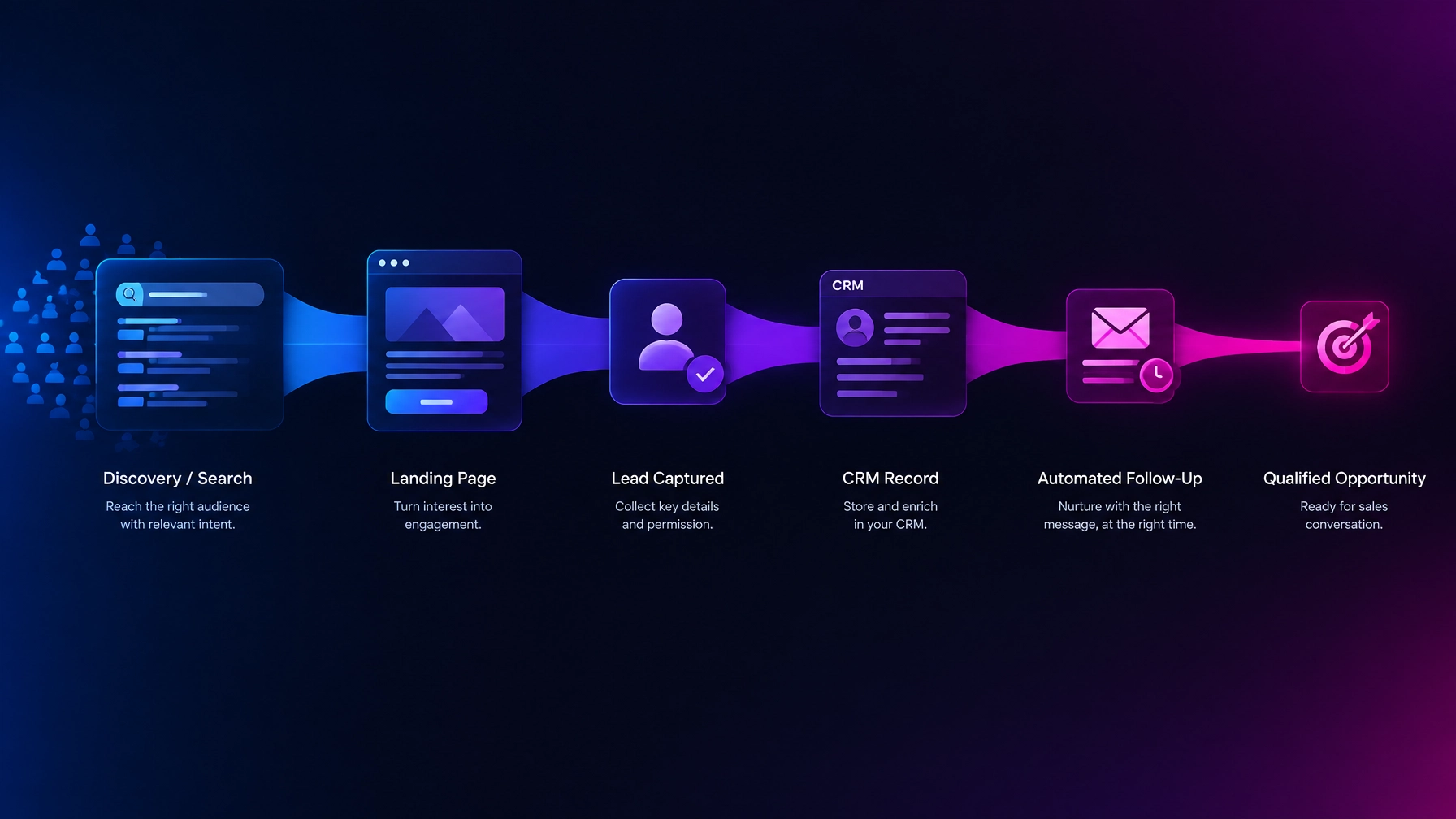



By Mark Lowe
A CRM should do more than store names and email addresses.
Marketing automation should do more than send scheduled messages.
Together, CRM and marketing automation create the operating layer behind consistent follow-up. They capture context, assign ownership, route leads, support useful communication, and return outcomes to your marketing decisions.
That structure matters because good marketing can lose momentum after the first conversion. A prospect submits a form, but no one knows who should respond. A sales conversation happens, but the context is not recorded. A lead goes quiet, and there is no plan to re-engage.
The problem is usually structural, not personal.
Your team may be working hard inside a system that does not make the next action clear.
CRM and marketing automation: two connected responsibilities
A CRM is the shared record of your relationships with prospects and customers.
It should show:
- Who the contact is
- Where they came from
- What they are interested in
- Which stage they are in
- Who owns the next action
- What has already happened
- What outcome followed
Marketing automation supports the actions around that record.
It can trigger confirmations, assign tasks, start nurture sequences, notify team members, update lifecycle stages, and pause communication when a contact replies or converts.
The distinction is useful.
CRM provides context. Automation creates consistency.
Neither should operate alone. A CRM without a process becomes an address book. Automation without context becomes a stream of disconnected messages.
The minimum viable data model
You do not need dozens of fields to create a useful foundation. You need the right fields, used consistently.
A minimum viable CRM data model should include:
- Contact: name, email, company, role, and other essential details.
- Source: how the person found you, such as organic search, referral, paid campaign, or direct inquiry.
- Lifecycle stage, where the person is in the customer journey.
- Owner: the person or team responsible for the next action.
- Offer: the service, resource, consultation, or campaign connected to the interaction.
- Next action: the specific follow-up that should happen next.
- Outcome: what happened after the interaction, such as contacted, qualified, opportunity, customer, or not a fit.
This structure gives your team a shared language.
It also makes reporting more useful. You can connect a lead to its source, offer, owner, stage, next action, and eventual outcome instead of measuring activity in isolation.
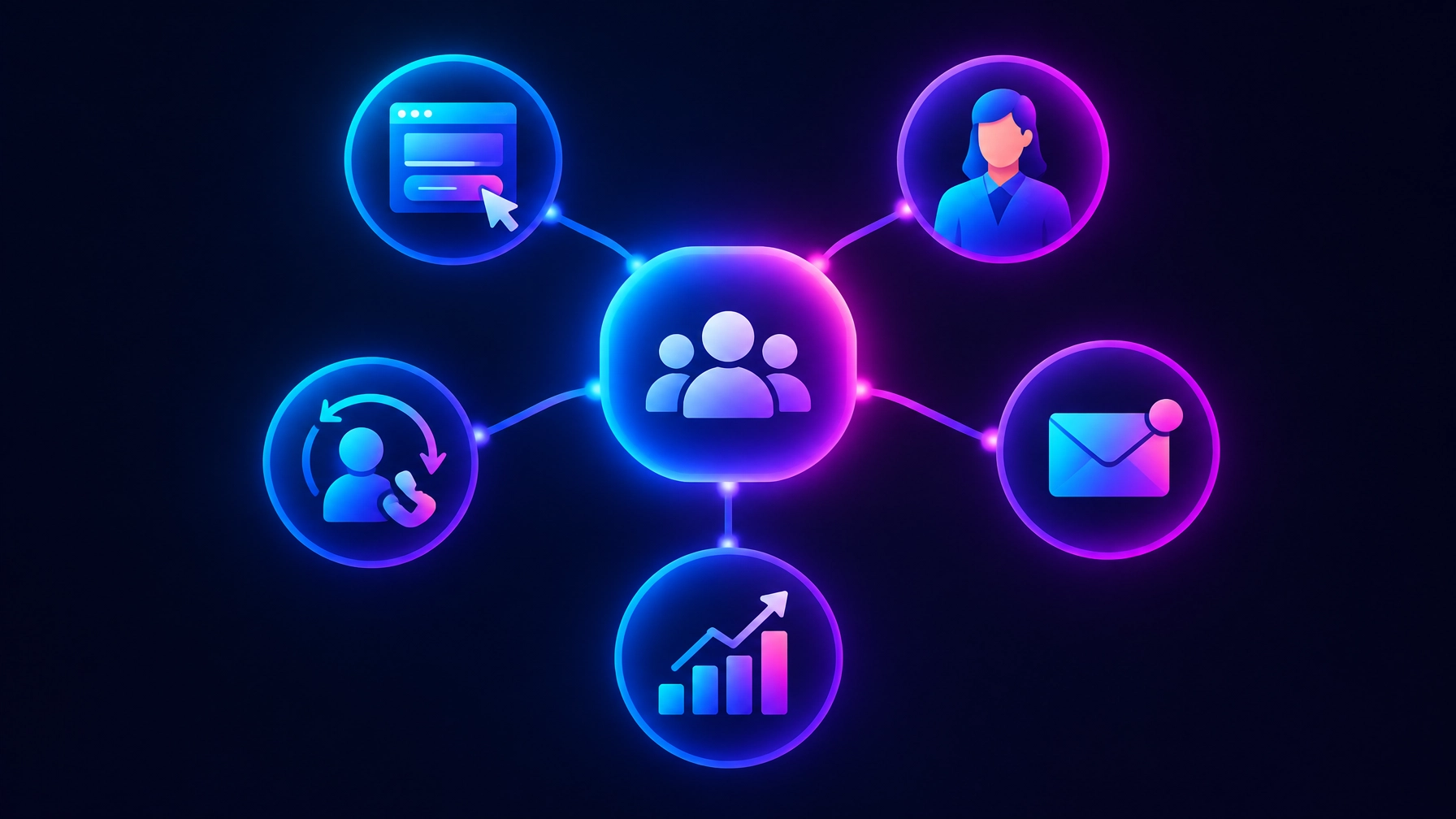
How the system supports the customer journey
CRM and marketing automation should support the journey from first known interaction through customer follow-up.
1. Lead capture
A meaningful form submission should create or update a CRM record.
The system should capture the contact’s details and useful context, including the page, offer, source, and stated need. This applies to website forms, landing pages, consultation requests, event registrations, and other conversion points.
The goal is simple:
Capture once. Preserve context. Create the next action.
This is one part of a broader connected marketing system, where websites, funnels, CRM, automation, and reporting work together rather than functioning as separate projects.
2. Lead routing
Lead routing determines who should handle the next step.
Routing rules may consider:
- Service requested
- Location or territory
- Company type
- Lead stage
- Account value
- Existing customer status
- Team availability
A qualified consultation request should not sit in a shared inbox without ownership. The CRM should assign the record, create a task, and notify the appropriate person.
Clear ownership creates accountability without adding unnecessary meetings.
3. Immediate acknowledgement
An automated acknowledgement confirms that the request was received and explains what happens next.
It may include:
- A confirmation message
- Expected response timing
- A calendar link
- A relevant resource
- Instructions for preparing for a conversation
This is not a substitute for human follow-up.
It is the bridge between the automated event and the personal response. The assigned team member should still review the context and respond thoughtfully.
A frequently cited Harvard Business Review analysis of online sales leads examined the importance of response speed. Published in 2011, it should not be treated as a current benchmark for every business, but its central lesson remains practical: delays can reduce the value of high-intent demand.
4. Nurture sequences
Not every lead is ready for a sales conversation.
A nurture sequence can provide useful information while the prospect evaluates the problem, compares options, or waits for the right internal timing.
A practical sequence may include:
- Immediate confirmation
- A useful resource related to the original offer
- An explanation of the next logical step
- A relevant example or case study
- A personal follow-up from the owner
- A re-engagement message if the contact becomes inactive
The sequence should reflect the person’s stage and interest. Automation should not send the same message to every contact.
Current marketing research continues to describe AI-powered workflows and automation as efficiency tools, but HubSpot’s 2026 State of Marketing report also emphasizes the importance of human-led judgment and authentic communication. The practical balance is clear: automate repeatable coordination, not thoughtful relationships.
5. Sales handoff
The handoff from marketing to sales should be defined before a lead becomes qualified.
Agree on:
- What makes a lead ready for sales
- What information must be included
- Who receives the lead
- How quickly the first human response should occur
- What happens when the prospect does not respond
- When the lead returns to nurture
A strong handoff preserves the conversation that marketing started.
For a broader look at the gaps that create delays and lost context, see our guide to marketing handoff problems.
6. Reactivation and closed-loop reporting
Some leads are interested but not ready. Others go quiet because priorities change.
Reactivation sequences can provide a respectful path back into the conversation. They may include a new resource, a useful update, a changed offer, or a simple preference question.
The system should also record what happens after follow-up.
Did the lead become qualified? Did a meeting occur? Did an opportunity open? Did the deal close? Was the contact not a fit?
This is closed-loop reporting. It connects marketing activity to sales outcomes and revenue.
Your marketing funnels should not end at the form submission. The CRM should help you understand what happened next.
Common failure modes
The CRM becomes an address book
Contact details are stored, but stages, ownership, next actions, and outcomes are missing.
Better approach: define the minimum data model and make the next action visible.
Automation runs without segmentation
Every contact receives the same sequence regardless of source, offer, stage, or behavior.
Better approach: create a small number of purposeful segments tied to real customer needs.
No owner is assigned
The lead enters the system, but responsibility remains unclear.
Better approach: use routing rules and automatic task creation.
There are no stop conditions
A contact books a meeting but continues receiving sales reminders. A customer remains in a prospect sequence.
Better approach: stop, pause, or change automation when a contact replies, books, converts, unsubscribes, or changes stage.
Data quality is inconsistent
Duplicate contacts, incomplete fields, and conflicting lifecycle stages weaken reporting.
Better approach: standardize field values, review duplicates, and assign responsibility for data hygiene.
The system is never tested
A workflow may appear complete while a form mapping, notification, or task assignment is broken.
Better approach: test every path with real-world scenarios before relying on it.
Opens become the main measure
Open rates and clicks can provide context. They do not show whether marketing created qualified opportunities.
Better approach: measure stage movement, response time, pipeline, revenue, and customer outcomes.
A practical implementation roadmap
You do not need to automate everything at once.
Phase 1: Clarify the journey
Define your lifecycle stages, qualification criteria, owners, and primary offers. Map the customer journey before selecting or changing tools.
For broader context, our guide to marketing operations strategy explains how people, processes, technology, and reporting work together.
Phase 2: Clean the foundation
Review existing records. Remove duplicates. Standardize fields. Decide which system owns each important data point.
Phase 3: Build one complete path
Start with one high-value workflow:
Form submission → CRM record → acknowledgement → owner assignment → human follow-up → nurture or sales stage → outcome.
Test that path thoroughly before adding complexity.
Phase 4: Add useful sequences
Build welcome, sales follow-up, event, reactivation, and customer onboarding sequences based on actual needs. Each workflow should have a trigger, audience, purpose, stop condition, and desired outcome.
Phase 5: Connect reporting
Track source, stage movement, response time, opportunities, and revenue. Use the results to improve messaging, offers, routing, and follow-up.
The operating cadence
A connected system improves through regular review.
Weekly
- Review new leads and unassigned records
- Check response times
- Inspect failed or incomplete automations
- Review stalled opportunities
- Confirm that high-intent leads received human follow-up
Monthly
- Review conversion between lifecycle stages
- Compare lead sources by quality and pipeline
- Clean duplicates and incomplete records
- Assess nurture sequence performance
- Review lost and closed-won outcomes
- Update routing rules and content where needed
Data governance should also be part of the operating rhythm. The NIST Privacy Framework offers a practical reference for identifying and managing privacy risk. For marketing teams, that means collecting only useful information, respecting consent, limiting access appropriately, and defining how long data should be retained.
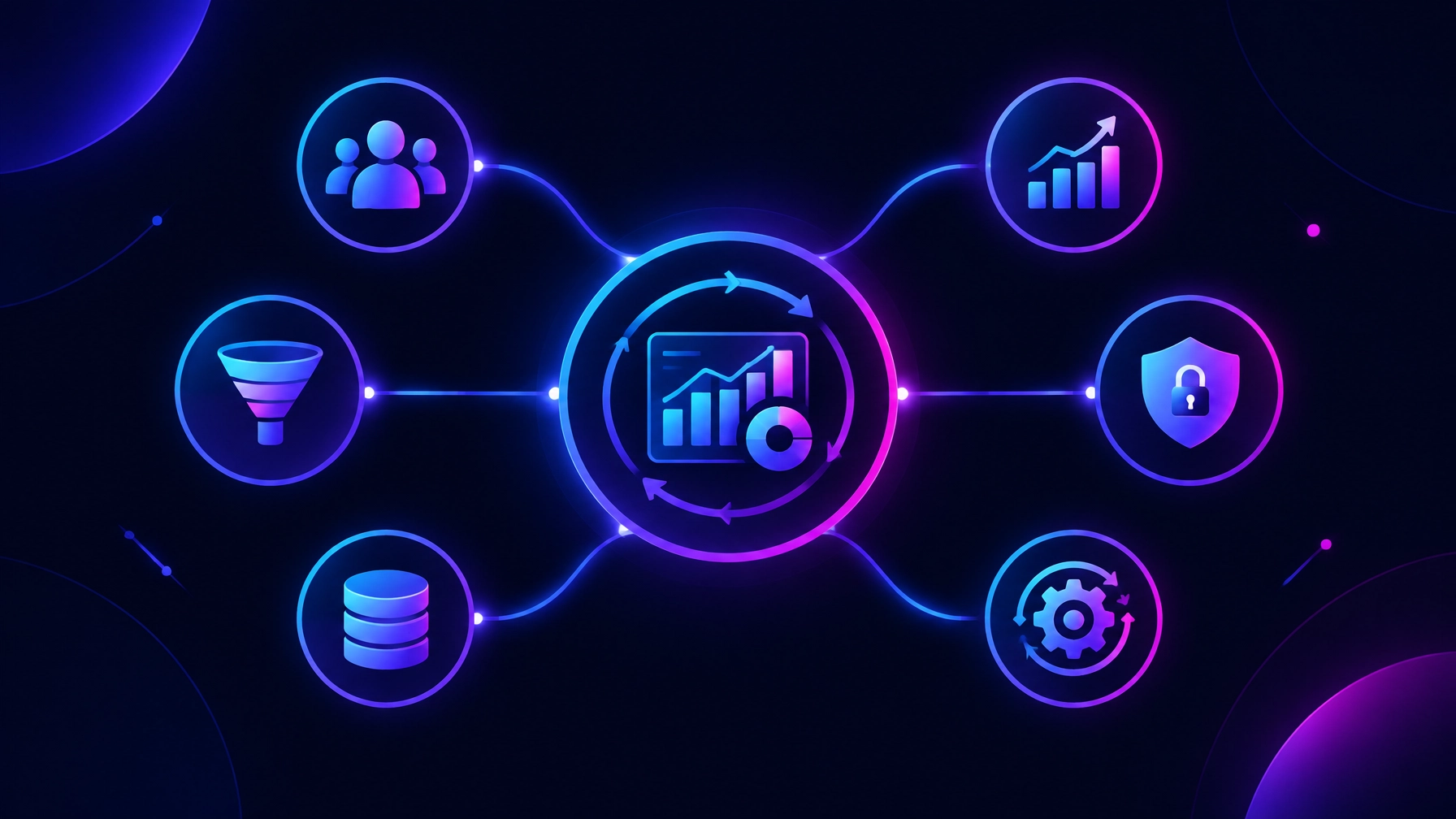
CRM and marketing automation checklist
Use this checklist to review your current setup:
- Does every meaningful lead enter the CRM?
- Is the original source recorded?
- Is the offer or conversion context visible?
- Does every qualified lead have an owner?
- Is an immediate acknowledgement sent?
- Does a human follow-up task get created?
- Are nurture sequences segmented?
- Does automation stop when the contact replies or converts?
- Are duplicate and incomplete records reviewed?
- Are sales outcomes returned to marketing reporting?
- Do weekly and monthly reviews have clear owners?
Build a dependable follow-up engine
CRM and marketing automation are not separate software projects.
They are connected parts of your marketing infrastructure. The CRM preserves context. Automation supports consistency. People provide judgment, relevance, and trust.
When these elements work together, your business can respond more clearly, reduce missed handoffs, and improve the customer journey over time.
Less memory. More structure.
Fewer gaps. Stronger momentum.
Holly Acre Media connects strategy, search visibility, websites, funnels, content, CRM, automation, and ongoing optimization into one practical system. Explore our marketing services or contact the team to discuss a clearer path from lead capture to revenue.