


By Mark Lowe
What it takes to become the answer in AI search?
1. The question you’re not in
Someone in your market opened ChatGPT last week and asked it to recommend a business like yours. They got a short, confident list: three names, maybe four, each with a one-line reason to pick them. Yours wasn’t on it.
You’ll never see that in your analytics. There’s no dashboard for a conversation you weren’t part of, no “impressions” counter for the questions that never returned your name. Which is exactly why this problem is so easy to miss and so expensive to ignore.
The uncomfortable part isn’t that AI got it wrong. It’s that AI didn’t have enough to work with in the first place. These systems don’t rank pages. They assemble answers from what they can find, understand, and trust about a business. If you’re not clearly defined across the web, you don’t lose the ranking. You don’t appear at all.
We ran this test on our own site before writing this. Holly Acre Media failed it too. More on that in section 11.
2. How AI answers actually get built
To fix this, you need to understand what’s happening under the hood. It isn’t a search results page with a summary on top.
Here’s the short version of the pipeline:
Retrieval. When someone asks a question, the model pulls relevant information from what it can access: a mix of training data, live search, and indexed sources.
Entity matching. It tries to identify the things being asked about: your business, your category, your location, your competitors. An “entity” is a distinct, recognizable thing, and if the model can’t confidently identify yours, it can’t recommend it.
Corroboration. It looks for agreement. Does your website say the same thing as your Google Business Profile, your directories, your reviews, and third-party mentions? Consistency increases confidence. Contradiction weakens it.
Citation. Finally, it names sources. Not always, and not always you, but being described consistently in multiple trusted places is what earns the mention.
Read that list again. Every step is about clarity, consistency, and external confirmation, not about how many keywords you placed or how many links you bought. That’s why traditional playbooks stall here.

3. Clicks are becoming citations
For twenty years, the goal was position. Page one, then position one. Every tool, every report, every agency retainer pointed at the same number.
That number still matters, but it’s no longer the whole game. Consider what changed:
| Then | Now | |
|---|---|---|
| Where research happens | Search results page | Often inside the AI answer itself |
| What you compete for | Position | Inclusion and citation |
| What the user sees | Ten blue links | A synthesized answer with a few sources |
| What determines success | Ranking signals | Being parsed, trusted, and referenced |
Research from the Pew Research Center points in the same direction. When an AI summary appears in Google results, users are less likely to click through to traditional links or the sources cited in the summary.
The practical consequence: a page ranking #1 can be completely absent from the AI answer that replaces it. And a smaller competitor with clearer, more consistent, better-structured information can be named ahead of you.
You’re not optimizing for a position anymore. You’re optimizing to be the source.
4. The three visibility layers, in practice
The pillar sets out the full framework: three surfaces, three disciplines, cumulative rather than alternative. The practical version is this. SEO builds the foundation these systems read, AEO makes your pages extractable, GEO makes your brand citable. Skip any one and the others underperform.
What matters for this article is the gap the framework exposes: most businesses have done the first and none of the second or third. That’s why they rank and still don’t get named.
Here’s the older comparison, still useful at a glance. It shows why the two disciplines produce different results:
| Traditional SEO | AEO | |
|---|---|---|
| Optimizes for | Rankings and clicks | Being the cited answer |
| Input | Keywords, backlinks, volume | Context, credibility, clarity |
| Output | A list of links | A single direct answer |
| Query style | “web design agency” | “what should I look for in a web design agency?” |
| Success metric | Position | Citation |
One system, three surfaces: the pillar explains the full framework.
For practical implementation, see our guide to Generative Engine Optimization.
5. The five reasons AI can’t describe you
If you ran the test and didn’t show up, it’s almost always one of these, usually two or three together.
1. You’ve never defined your entity. What is your business, precisely? Not a tagline: a definition. Name, category, what you do, who you do it for, where you operate. If you haven’t written that down in a consistent form, no model is going to infer it from a homepage hero.
2. There’s no structured data on your site. Schema markup is how you tell machines what a page is about without asking them to guess. Many business sites have none, which means every system reading the site is working from inference.
3. Your content is written for readers, not for extraction. Long preambles, buried answers, clever headings. Humans tolerate it. Parsers don’t. They pull the first clear, self-contained statement they find, and if you buried yours, someone else’s gets pulled instead.
4. Nobody else corroborates you. Your website says you’re the best. That’s not evidence. What earns confidence is a consistent picture across sources you don’t control: reviews, directories, industry sites, community discussions, podcasts.
5. Your details contradict each other. Two different email addresses, three phone number formats, an old address on a directory, a service description that’s changed twice. Each inconsistency is a small amount of doubt added to the pile.
6. Do you have this problem? A 15-minute self-test
You don’t need a tool to find out. You need an afternoon and a willingness to look at the current picture clearly.
Step one: build your prompt set. Write 15–20 questions a real buyer would ask, in their words:
- Recommendations: “Who are the best [your category] in [your city]?”
- Comparisons: “[You] vs [competitor]”
- Category questions: “What should I look for in a [your category]?”
- Specific problems: “Who helps with [the problem you solve]?”
- Brand: “What does [your company] do?”
Step two: run them across four engines. ChatGPT, Perplexity, Google AI Overviews, and Gemini, one fresh conversation each, with no follow-ups.
Step three: log it. For every prompt, note:
| Prompt | Engine | Were you named? | Were you cited? | Who was named instead? |
|---|---|---|---|---|
| Y / N | Y / N |
How to read your results:
- Named in 0–2 of 20: you’re effectively invisible. This is a common result for small and mid-sized businesses.
- Named in 3–7: you exist, but you’re not a default choice. Fixable with focused improvement.
- Named in 8–15: you have a real footprint. The work is optimization, not construction.
- Named in 15+: you’re ahead of many businesses. Now defend it.
Save the raw output. You’ve just built a baseline, and it’s the only way to know whether anything you do next actually works.
7. Fixing the foundation: entity and schema
Start here, because everything else builds on it.
Define the entity once, then use that exact language everywhere. Write a single canonical paragraph covering what you do, who for, where, and what makes you distinct. Then use it, verbatim or near-verbatim, on your homepage, your about page, your Google Business Profile, your social bios, and your directory listings. Vague variation is the enemy. Consistency is the signal.
Add Organization and LocalBusiness schema. Structured data states your name, URL, logo, contact details, service area, and social profiles in a format machines can read directly. This is not a ranking hack. It removes ambiguity, which is the actual goal.
Add FAQPage schema to question-based content. If your page answers real questions, mark it up that way. It’s one of the clearest signals you can send about what a page contains.
Clean up duplicates and inconsistencies. Consolidate duplicate URLs, standardize your contact details, and make sure your description matches across every platform. Boring work with an outsized effect.
8. Fixing the content: answer-shaped structure
Once the foundation’s in place, the content has to be built for extraction.
Answer first, then explain. Every section should open with a direct, self-contained answer in the first 50–60 words. If a model pulled only that paragraph, it should still be correct, complete, and usable. Depth and nuance come after.
Make the headings literal questions. “How long does it take?” beats “Timing Considerations.” You’re not simplifying the subject. You’re making the structure match how people actually ask.
Keep answers self-contained. Don’t rely on the previous section for context. Each block should stand alone, because it may be read alone.
Be specific. Named processes, concrete numbers, real examples. Specificity reads as credibility to both humans and models, and it’s the thing generic content can’t fake.
Cut the preamble. This is the single highest-leverage edit available to most businesses. Almost every page buries its best sentence under two paragraphs of throat-clearing.
Then write new content in the shape of questions people actually ask. Not keyword lists. Use the real questions from sales calls, support tickets, and inbound emails.
9. Fixing the corroboration: citation seeding
This is the part almost everyone skips, because it happens off your website.
AI models cross-reference. They weigh what the rest of the web says about you, not just what you say about yourself. So you need to be present, accurately, in the places these systems pull from:
- Review platforms: Google, industry-specific directories, Trustpilot. Volume and recency both matter.
- Business directories: consistent NAP data, complete profiles, correct categories.
- Community discussions: Reddit, Quora, industry forums. Frequently cited directly, because they contain unpolished, first-person answers.
- Video and audio: YouTube, podcasts. Transcribed, indexed, and increasingly pulled into answers.
- Industry publications and roundups: the “best of” lists and comparison articles that models lean on for recommendation queries.
- Partnership and association pages: memberships, certifications, vendor listings.
A single accurate mention on a trusted third-party site can outweigh several pages on your own. That’s the part that feels backwards if you’ve spent a decade in SEO, and it’s the part most businesses haven’t acted on yet.
This also connects to Google’s guidance on helpful, reliable, people-first content. Original information, clear authorship, relevant expertise, trustworthy sourcing, and useful content give both people and systems better reasons to rely on what you publish.
10. How to know it’s working
Track four things, monthly:
- Mentions: how often you’re named across your prompt set
- Citations: how often you’re linked as a source
- Share of voice: your mentions versus the competitors in the same prompts
- Accuracy: whether what’s said about you is correct, which matters as much as frequency
Report trends, not snapshots. AI answers vary by model, by phrasing, and by day. A single query is noise. Ten prompts tracked monthly over six months is a signal.
11. Your next 30 days
Week 1: Measure. Build your prompt set. Run it across all four engines. Save every output. You now have a baseline.
Week 2: Fix the foundation. Write your canonical entity definition. Add Organization or LocalBusiness schema. Consolidate duplicate URLs and standardize your contact details everywhere.
Week 3: Restructure. Take your three highest-value pages and rewrite their openings so each section leads with a direct answer. Add FAQ schema.
Week 4: Seed. Claim or correct your listings on the five most relevant directories and review platforms in your industry. Get one accurate third-party mention live.
Then re-run your prompt set. Compare it to week one. That’s your first real data point.
A note on our own numbers. We wrote this because we had the problem. A 90-day look at our own search data showed roughly ten clicks, most pages sitting between positions 10 and 90, duplicate URLs splitting our own signal, and three posts competing for the same query. No tool would have flagged any of it as urgent. That’s the nature of this shift. It’s invisible until it isn’t.
If you’d rather not run the 15-minute version and guess at the results, we built something more precise: a full AI Visibility Audit that tests your brand across all four engines, benchmarks you against three named competitors, and delivers a scored report with the specific gaps and the fix order. It’s the measured version of the self-test in section 6, and it’s the starting point for everything above.
Clearer visibility. Stronger direction.
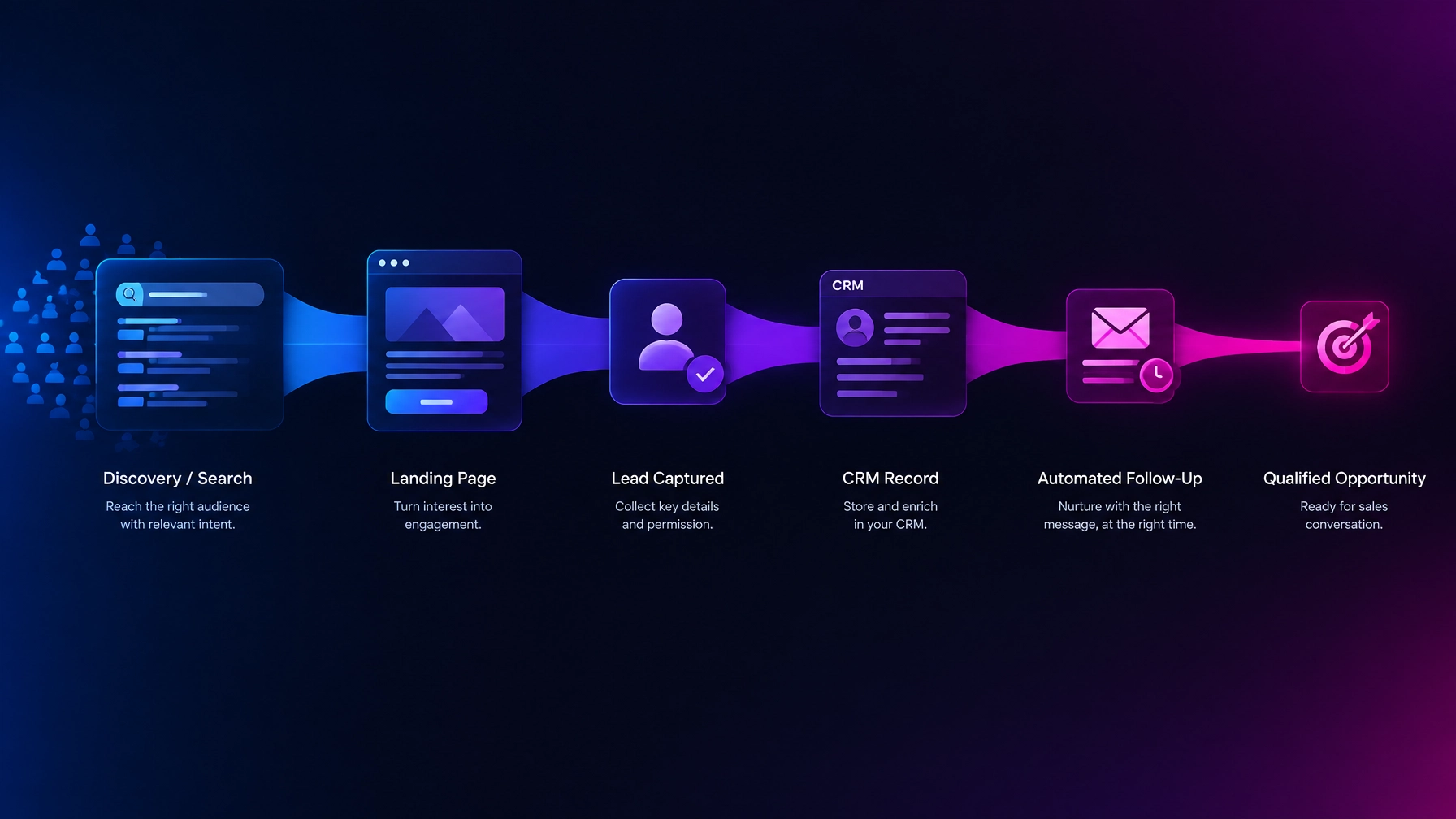
At Holly Acre Media, we connect visibility, websites, content, funnels, CRM, automation, and ongoing improvement into one consistent marketing system. Explore our services or send us a message when you are ready to review what is working, what is disconnected, and what should improve next.
Less noise. More connection.
Clearer answers. Stronger momentum.