


SEO is not dead.
The model changed. It will continue to change. But the underlying discipline remains essential: helping the right people find, understand, trust, and choose your business at the moment of decision.
What changed is the relationship between visibility and the click.
The old model was simple:
Rank. Earn the click. Convert the visitor.
That model is no longer complete. Search results now include AI Overviews, featured answers, local packs, product information, videos, forums, and other experiences that can satisfy part of a query before someone visits a website.
The click model expanded.
SEO did not disappear.
The better way to understand the shift is this:
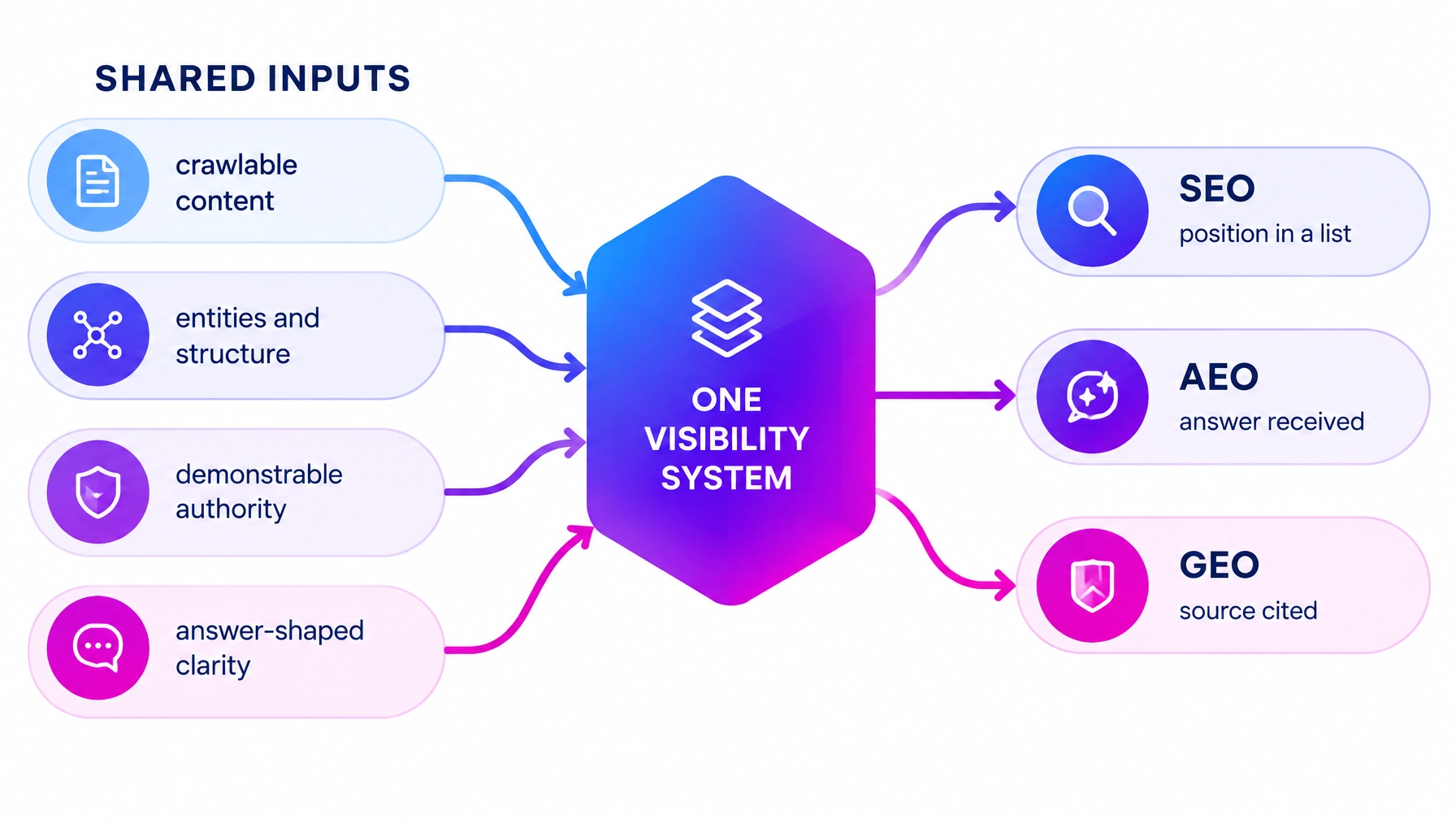
The click model died, not SEO. The answer is not three separate strategies. It is one visibility system pointed at three surfaces.
Those three surfaces are:
- SEO: A position in a list.
- AEO: The answer someone receives.
- GEO: The source a generative system cites.
One source. One system. Three destinations.
The claim, stated plainly
The phrase “SEO is dead” is a misnomer because it often refers to two different ideas.
The first idea is traditional traffic-focused SEO. This approach treats rankings as the main objective and clicks as the primary proof of success.
That model is under pressure.
The second idea is search visibility as a business discipline. This includes technical accessibility, useful content, authority, structured information, customer intent, and the ability to be found when someone is actively looking for a solution.
That discipline is not dead. It is becoming more important.
People still search. They search through Google, Bing, YouTube, maps, marketplaces, social platforms, voice assistants, and generative tools. They still compare options. They still look for evidence before making decisions.
The interface is changing.
The need for credible visibility is not.
How the click model changed
For years, many SEO programs were evaluated through a straightforward sequence:
- A page ranks.
- A searcher clicks.
- The visitor reads the page.
- The visitor takes action.
That sequence still happens. It is simply no longer the only way search creates value.
AI-generated summaries and richer search results can answer basic questions directly on the results page. A searcher may see a summary, compare several sources, and decide not to visit any of them.
This is the zero-click reality.
A Pew Research Center analysis of 68,879 Google searches found that users clicked a traditional search result in 8% of visits when an AI summary appeared, compared with 15% when no AI summary appeared.
Only 1% of visits with an AI summary involved a click on a link inside that summary.
The study also found that users were more likely to end their browsing session after seeing an AI summary: 26% of visits compared with 16% when a summary did not appear.
These figures should be treated as directional rather than permanent benchmarks. Search interfaces continue to change, and behavior varies by query, industry, intent, and device.
The larger pattern is clear:
Visibility and website visits are becoming less directly connected.
A page can appear in the research process without receiving a click. A brand can influence a decision before a prospect reaches its website. A source can be used to support an answer without becoming the next page someone visits.
That does not make visibility less valuable.
It changes how visibility must be understood and measured.
What did not break
The fundamentals remain.
Search engines and answer systems still need to discover, interpret, evaluate, and retrieve information. They still need signals that help them understand what a business does, who it serves, what its content means, and whether the information is reliable.
The essential inputs include:
Crawlability and indexation
If search systems cannot access or understand your important pages, those pages have limited opportunity to appear anywhere.
Technical hygiene still matters:
- Clear site architecture
- Accessible pages
- Accurate indexation
- Strong internal linking
- Mobile usability
- Reliable performance
- Clean canonical signals
- Useful page titles and descriptions
These are not outdated technical details. They are the access layer for every visibility surface.
Entities and structure
Search systems need to understand the relationships between your business, services, locations, people, products, topics, and claims.
This is where entity clarity matters.
Your business should be consistently described across your website and relevant external sources. Your service pages should connect logically to your organization. Authors should have identifiable profiles. Structured data should reinforce information that is visible and accurate on the page.
Schema does not guarantee a ranking or an AI citation. It helps create a clearer representation of what your pages contain.
Topical depth
Thin pages built around isolated keywords are increasingly fragile.
Useful visibility comes from covering a subject with enough depth to answer the questions that surround a decision. That includes definitions, comparisons, risks, implementation considerations, examples, and next steps.
Depth does not mean unnecessary length. It means meaningful coverage.
Demonstrable authority
Trust has always mattered. It now has more places to show up.
A searcher may not read every paragraph on your website. A generative system may not reproduce your entire article. But both need reasons to believe that your information deserves attention.
That evidence can include:
- Accurate bylines
- Author biographies
- First-hand experience
- Original analysis
- Clear sourcing
- Relevant case studies
- Consistent brand information
- Recognized expertise
- Useful external references
Google’s guidance on helpful, reliable, people-first content emphasizes originality, expertise, authorship, trust, and creating content for people rather than for rankings alone.
Those principles apply well beyond traditional search.
The prism model: one system, three surfaces
The clearest visual model is a prism.
White light enters the prism as one source. The prism does not create three unrelated lights. It refracts one beam into distinct colors.
The same principle applies to modern search visibility.
One set of strategic inputs can project onto three different surfaces:
- A traditional search result
- A direct answer
- A generative citation
The shared inputs
The system depends on four connected inputs:
- Crawlable content
Information that search and answer systems can access and retrieve. - Entities, structure, and schema
Clear relationships between your organization, people, services, topics, and locations. - Demonstrable authority
Evidence that your business and authors understand the subject. - Answer-shaped clarity
Content that responds directly to real questions before expanding into useful depth.
These inputs support all three surfaces.
Surface one: SEO
SEO is the traditional search surface.
The outcome may be a position in a list of organic results, a local result, a featured result, or another search feature.
The user may click through to your website. They may also see your listing and continue researching elsewhere.
The ranking still matters. The click still matters. They are simply no longer the whole picture.
Surface two: AEO
AEO, or Answer Engine Optimization, focuses on being present in the answer someone receives.
That answer may appear in a featured snippet, voice result, AI-powered search summary, or another direct-response format.
AEO requires clear answers to clear questions. It benefits from concise definitions, useful headings, relevant FAQs, structured content, and language that reflects how people actually ask for help.
The destination is not necessarily a page visit.
The destination is recognition inside the answer.
Surface three: GEO
GEO, or Generative Engine Optimization, focuses on visibility inside generative systems.
The goal is not to manipulate a chatbot. It is to make your business and content understandable, relevant, credible, and suitable for citation when a model assembles a response.
GEO may include:
- Clear brand and service entities
- Consistent information across trusted sources
- Strong authorship
- Original insights
- Citation-ready explanations
- Content that addresses complex decisions
- A presence across relevant search and information environments
The destination is being named, referenced, or cited as a credible source.
For a practical walkthrough of how to apply these principles, see our guide to Generative Engine Optimization.
Going deeper on each surface
This pillar defines the visibility system as a whole. Deeper implementation guides live in the cluster beneath it:
- Generative Engine Optimization: How to Get Found by AI Search covers the practical GEO tactics — restructuring content around direct answers, tightening structural signals, and building consistency across the web.
- Our SEO and content work is covered in SEO content strategy, and the technical foundation in our technical SEO audit guide.
Each of these is an expression of the same system described here, not a separate discipline.
AEO and GEO are not extra layers bolted onto SEO
This distinction matters.
When teams treat SEO, AEO, and GEO as three separate disciplines, they often create three half-systems:
- One team optimizes pages for rankings.
- Another rewrites content for answers.
- A third monitors AI citations.
- No one owns the shared structure underneath.
That creates duplicated work and inconsistent priorities.
A page may be optimized for a keyword but unclear about the business behind it. Another may answer a question but lack authority. A third may contain strong ideas but remain difficult to crawl or connect to the rest of the website.
The problem is not a lack of activity.
It is a lack of alignment.
A connected approach begins with the shared input layer. It creates content that is accessible, structured, authoritative, and clear. Then it considers how that content should appear across each destination.
Same fuel in. Different destination out.
That is the prism model.
Why real authorship carries more weight now
There has always been a difference between content that is technically present and content that deserves trust.
The difference is more visible in an AI-mediated search environment.
When a person reads a page, they can assess tone, specificity, experience, and evidence. When a system synthesizes an answer, it must decide which sources appear reliable enough to use.
Clear authorship adds an important trust signal.
A page with a real byline, a relevant biography, a clear editorial purpose, and evidence of experience gives readers and systems more context. Without that clarity, a page can feel interchangeable.
This does not mean adding a name to generic content is enough.
Strong authorship should be supported by:
- A genuine author profile
- Relevant experience
- First-hand observations
- Original opinions
- Clear sourcing
- Specific examples
- Consistent expertise across the site
AI-assisted content can still be useful. The important questions are who shaped it, how it was reviewed, and whether it adds something meaningful beyond a summary of information already available.
Generic content is easy to generate.
Credible perspective is harder to replace.

What to do now
The answer is not to abandon SEO and start three new programs.
The better approach is to strengthen the shared visibility system.
1. Create answer-shaped content
Start with the questions your audience asks before choosing a provider.
Then structure the content so it can work at several levels:
- A direct answer near the beginning
- Supporting explanation beneath it
- Evidence, examples, or qualifications
- A clear next step
- Internal links to related decisions
Answer-shaped content is not shallow content. It gives the reader a clear entry point before providing depth.
2. Clarify your entities
Review how your organization, services, people, locations, and offers are described.
Use consistent naming. Connect related pages. Make it clear who provides each service and how the services relate to one another.
Use appropriate structured data where it accurately reflects visible page content. Depending on the business, that may include Organization, Person, LocalBusiness, Service, Article, or other relevant types.
3. Strengthen author trust signals
Add accurate bylines. Build useful author pages. Explain relevant experience. Link to supporting credentials or work where appropriate.
Do not treat authorship as a decorative field.
Treat it as part of the information architecture.
4. Improve technical hygiene
Review:
- Indexation
- Internal links
- Duplicate pages
- Broken links
- Page speed
- Mobile usability
- Canonicalization
- XML sitemaps
- Structured data
- Search Console coverage
- Important pages that are difficult to discover
A strong content strategy cannot compensate for a site that is difficult to access or interpret.
5. Prioritize decision content
Create content that helps someone make a meaningful choice.
That may include:
- Service pages
- Comparisons
- Pricing considerations
- Implementation guides
- Local decision content
- Buyer’s guides
- Common objections
- Case studies
- Process explanations
- “What happens next” content
This content is harder to replace with a generic summary because the reader still needs context, judgment, and confidence.
6. Widen measurement
Rankings remain useful. Organic traffic remains useful. Conversions remain essential.
But the measurement layer should also consider:
- Inclusion in AI Overviews
- Citations in generative answers
- Brand mentions
- Branded search growth
- Direct traffic
- Assisted conversions
- Qualified leads
- Revenue influenced by organic visibility
- Visibility across relevant answer and search platforms
Not every AI citation produces a measurable click. Not every click represents the full value of prior visibility.
The goal is not to abandon measurement.
It is to measure the whole path more honestly.
Why the case for SEO is stronger than it looks
“SEO is dead” is not a new claim.
It has been declared dead through mobile shifts, voice search, featured snippets, major algorithm updates, and the rise of “position zero.”
Each time, the discipline adapted.
The pattern is change, not extinction.
That view rests on a narrower definition of SEO than most businesses actually use.
It assumes SEO means winning the click.
That was only ever the delivery mechanism.
The discipline itself is broader: being findable and credible at the moment of decision.
That need has not weakened.
If anything, it has become more important because buyers now research across more surfaces before they ever make contact.
AI systems did not become independent of the web.
They read it. Summarize it. Cite it.
They still depend on crawlable, structured, credible, clearly written source material.
That raises the value of clean structure and genuine authority.
Those are not new requirements. They are core parts of good SEO.
The evidence points the same direction.
Search engines still drive the overwhelming majority of referral traffic. Semrush reported roughly 86% of U.S. referral share in early 2026 came from search engines, compared with about 0.2% from AI chatbots.
AI inserted itself between the query and the click.
It did not replace search.
The bigger risk is quieter than that. When a business decides visibility no longer matters, the work simply stops.
Indexed content weakens. Entity clarity fades. Internal linking gets neglected. Authority erodes over time.
That decline is not something AI imposed. It reflects a choice to stop building an asset that compounds.
Visibility work does need to adapt.
But adapting is not the same as dying.
This is not a discipline that ended.
It is a discipline whose destination changed.
The teams that quit now may spend the next few years paying to rebuild what they let go.
Where the opportunity is moving
The value is concentrating in more purposeful types of content.
Some content categories are losing value.
Generic informational content that answers a simple question may now be summarized without a visit. High-volume content created mainly to attract impressions may generate less traffic and weaker commercial value.
That does not mean informational content has no role. It means every piece needs a clearer purpose.
Does it build authority? Support a service page? Help someone compare options? Answer a complex question? Create demand for a meaningful next step?
If the answer is no, the content may be contributing activity without contributing direction.
At the same time, content connected to a real decision may become more valuable.
A prospect may use an AI tool to create a shortlist. They may still visit a provider’s service page to assess fit. They may still look for evidence, process, pricing context, experience, and a clear next step.
The click may happen later in the journey.
When it does, the quality of that click may matter more.
How this differs from SEO vs. CRO
Holly Acre Media’s SEO vs. CRO guide addresses a different question.
That article explains how to identify the main bottleneck between visibility and conversion. It helps determine whether your immediate priority should be attracting more qualified attention or improving the experience for visitors who are already arriving.
This pillar addresses the visibility system itself.
It explains how SEO, AEO, and GEO work together as search behavior changes. It focuses on how your business can remain findable and credible across traditional results, direct answers, and generative citations.
The two ideas connect, but they should not be confused:
SEO, AEO, and GEO determine how you are found. CRO determines how more of that attention becomes action.
Both belong in a connected marketing system.
Frequently asked questions
Is SEO dead because of AI search?
No. SEO is not dead. The click-focused model has changed as search engines provide more answers directly through AI Overviews and other search features. The underlying work of making a business discoverable, understandable, and credible remains important.
What is the difference between SEO, AEO, and GEO?
SEO focuses primarily on visibility in search results. AEO focuses on appearing in direct answers. GEO focuses on being referenced or cited by generative systems. They are different destinations supported by many of the same inputs.
Is GEO replacing SEO?
No. GEO should not replace SEO. It should be treated as part of a broader visibility system that includes technical accessibility, content quality, entity clarity, authority, and search intent.
What is AEO in simple terms?
AEO means structuring your content so answer engines can understand and use it when responding to a question. Clear answers, useful headings, structured information, and credible sources all support this goal.
Does schema guarantee AI citations?
No. Schema can help search systems interpret information, but it does not guarantee rankings, AI Overviews, or citations. It should support accurate, visible content rather than replace it.
Should businesses still invest in SEO consulting services?
Yes, provided the work is connected to business outcomes. Modern SEO consulting services should consider technical health, content, search intent, conversion paths, entity clarity, authority, and visibility across traditional and generative search surfaces.
What type of content is most valuable in AI search?
Content that supports a real decision is often more valuable than generic information. Service pages, comparisons, implementation guidance, case studies, original research, and expert commentary can provide context that a short AI summary cannot fully replace.
This is the system
The future of search visibility will not be defined by one acronym.
It will be defined by how well your information system works as a whole.
Your content must be accessible. Your structure must be clear. Your entities must connect. Your authors must be credible. Your answers must be useful. Your website must give interested people a meaningful next step.
Then the system can project onto the surface where the decision is happening:
- A search result.
- An answer.
- A citation.
This is why AEO and GEO should not be managed as disconnected additions to SEO. They are expressions of the same underlying discipline.
One system. Three surfaces.
Less noise. More direction. Stronger visibility.
At Holly Acre Media, we bring strategy, search, websites, content, funnels, CRM, automation, and ongoing improvement into one connected marketing system. If your visibility feels scattered or your current SEO approach was built for a search environment that no longer exists, explore our services or send us a message.