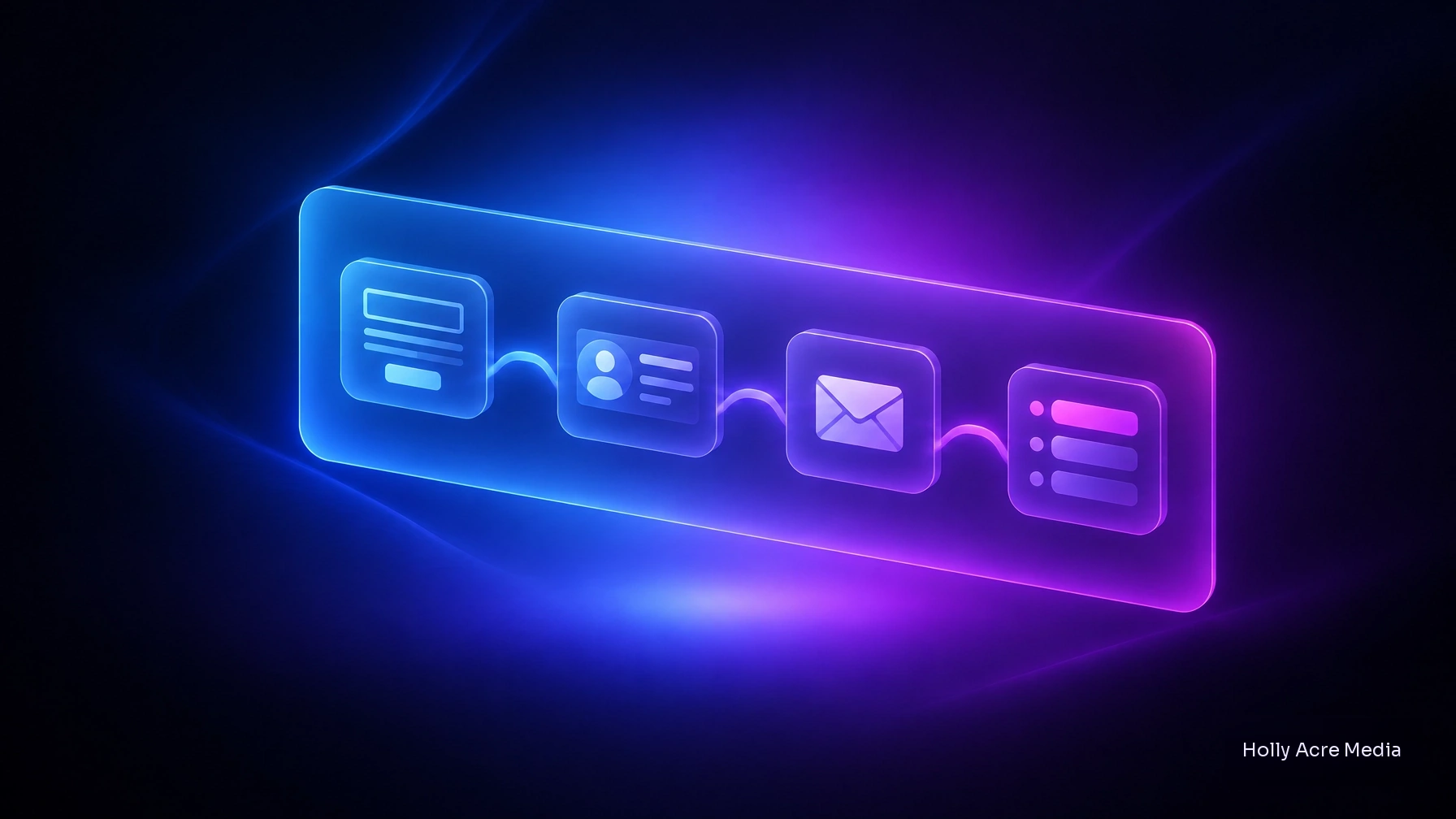



A lead follow-up system is the connected process that captures an inquiry, assigns an owner, prompts a useful next step, and records what happened. It is more than a sequence of emails. When one step is unclear, leads sit in an inbox, receive duplicate messages, or disappear between tools. A well-designed process makes the next action clear and visible.
Those gaps are systems issues, not personal failings. A well-designed system makes the next action clear, so your team can respond consistently and improve over time.
Start With One Clear Lead Journey
Before setting up reminders or automation, map the path a new inquiry should take:
Visibility → offer and landing page → form submission → CRM record → assigned owner → follow-up → outcome
Every stage has a job. SEO, AEO, and GEO help the right people discover your business. Your website and funnel explain the offer and guide an interested visitor to act. Marketing infrastructure passes the inquiry and its context to your CRM. CRM, automation, and follow-up help your team carry the conversation forward.
That whole journey matters. Faster follow-up cannot compensate for an unclear offer or a broken form-to-CRM connection. Likewise, strong visibility is less useful when qualified inquiries have no clear next step.
For the wider view, see our B2B lead generation strategy and marketing systems integration framework.
Set a Response Standard Your Team Can Meet
Define how quickly high-intent leads should receive a human response, then make that expectation achievable through routing, notifications, and clear coverage.
Recent studies offer useful reference points, though their samples and methods differ. In its 2025 study of 1,333 U.S. law firms, Hennessey Digital reported that 25% responded to online inquiries within five minutes, 56% within an hour, and 26% did not respond within seven days. The study measured the time to first personal outreach, not just an automated acknowledgment.
A separate RevenueHero test of 1,000 B2B SaaS demo-request forms received responses from 365 companies. Among those, the average response time was one day, five hours, and 17 minutes. RevenueHero counted automated responses, so the results are not directly comparable to Hennessey Digital’s measure of personal outreach.
The practical lesson is not that every business needs the same response-time target. It is that you should set a clear standard for your own lead types, business hours, and team capacity, and measure whether the process meets it.

Acknowledge automatically. Respond personally. An immediate confirmation can reassure someone that their inquiry arrived and explain what happens next. It does not replace a human response when a person needs guidance, a conversation, or a tailored answer.
Give Every Lead an Owner and a Next Action
A notification in a shared inbox may alert the team, but it does not establish who is responsible. Assign each new inquiry to a person or defined queue using rules your team can understand and maintain.
Routing may be based on service interest, location, account ownership, or availability. Whatever the rule, write the assignment into the CRM. Then create a visible next action, such as a call task, a scheduled review, or a relevant email.
Your CRM record should preserve the context needed to respond well: what the person asked about, which offer or page prompted the inquiry, and any useful information they submitted. That context helps your team avoid asking someone to repeat what they have already shared.
A strong handoff answers three questions:
- Who owns this inquiry?
- What should happen next?
- Where can the owner see the context?
Our guide to integrating your CRM with marketing funnels covers the form fields, source data, routing rules, and stop conditions that help keep this handoff intact.
Build Follow-Up Around Useful Steps
A dependable follow-up sequence is consistent, relevant, and easy to stop when circumstances change. It should help a lead make an informed next decision, not simply send more messages.
For an inbound inquiry, a practical sequence might include:
- Confirmation: Acknowledge the request and set expectations.
- Personal response: Have the assigned owner respond with information relevant to the inquiry.
- Helpful follow-up: If there is no response, offer a useful next step or answer a likely question.
- Continued nurture: If the person is not ready to speak, share relevant information at an appropriate pace.
- Review or close: Record the outcome and decide whether a future follow-up makes sense.
Use each touchpoint to add context or make the next step easier. Repeating the same “just checking in” message rarely gives someone a new reason to respond.
Persistence should also be appropriate to the channel and relationship. In its analysis of more than 7.5 million emails sent in 2025, Belkins reported that steps two through six collectively accounted for 58.6% of email replies in its B2B outreach dataset. That finding concerns outbound email sequences, not inbound lead response, so it should not be treated as a universal sequence prescription. It does reinforce one useful principle: a thoughtful first message may not be the only touchpoint that earns a response.
Add Automation With Clear Stop Conditions
Automation is useful for reducing routine delay and making handoffs dependable. It can send confirmations, assign records, create tasks, and continue relevant nurture when a lead is not ready to speak.
It should also recognize when the situation has changed. Before each automated message, check whether the person has replied, booked a meeting, opted out, become a customer, or entered an active opportunity. Those events should pause or end the sequence where appropriate.
Test the full journey, not just whether the email sends. Submit a test inquiry, confirm that the CRM record contains the right source and offer, check that ownership is assigned, and verify that a reply stops the next automated step.
Mark Lowe, founder of Holly Acre Media, said: “A lead follow-up system works when the next action is clear, assigned, and visible, not when people have to remember what the system should do.”
Measure What Helps You Improve
A small, consistent scorecard is more useful than a crowded dashboard. Start with measures that show whether inquiries are moving through the system:
- Response time: How long it takes for a person to follow up.
- Unassigned leads: How many records lack an owner.
- Follow-up completion: Whether the planned actions happened.
- Lead progression: How inquiries move to qualified opportunities and outcomes.
- Source quality: Which visibility channels and offers bring relevant inquiries.
Review the measures together. A response-time gap might point to unclear ownership or limited coverage. A high number of unassigned leads may indicate a routing or integration issue. If inquiries arrive but do not progress, revisit the offer, qualification, or follow-up approach.

Make the System Easier to Trust
You do not need to replace every tool or rebuild every campaign to improve lead follow-up. Start with one important lead path. Map it, assign clear ownership, set a response standard, and test the workflow from submission through outcome.
Then connect the work to the rest of your marketing. Visibility brings qualified attention. Websites and funnels guide people toward a clear next step. Marketing infrastructure preserves context between tools. CRM, automation, and human follow-up keep the conversation moving.
Less uncertainty. More consistency. That is the foundation of a lead process your team can rely on and improve.
If your lead journey feels difficult to trace, send Holly Acre Media a message to discuss a clearer path from visibility to follow-up.
Frequently Asked Questions
What is a lead follow-up system?
A lead follow-up system is the connected process for capturing inquiries, assigning ownership, responding, scheduling next steps, and recording outcomes. It may use a CRM and automation, supported by clear rules and human follow-through.
How quickly should you follow up with a new lead?
Set a response standard that reflects your lead type, customer expectations, business hours, and team capacity. Make sure your process can meet it consistently, and measure actual human response time separately from automated acknowledgments.
How many follow-up messages should you send?
There is no single sequence length for every business or channel. Use a planned set of relevant touchpoints, adjust the pace to the relationship, and stop when someone replies, opts out, books, or otherwise changes status.
What should happen when a lead replies?
The reply should reach the assigned owner, pause any inappropriate automated messages, and prompt a clear next action in the CRM. Make sure the person responding can see the original inquiry and its source context.
What is the first step to fixing a follow-up process?
Map one lead journey from form submission through outcome. Check that each inquiry creates or updates the right CRM record, retains useful context, receives an owner, and triggers the intended next step.