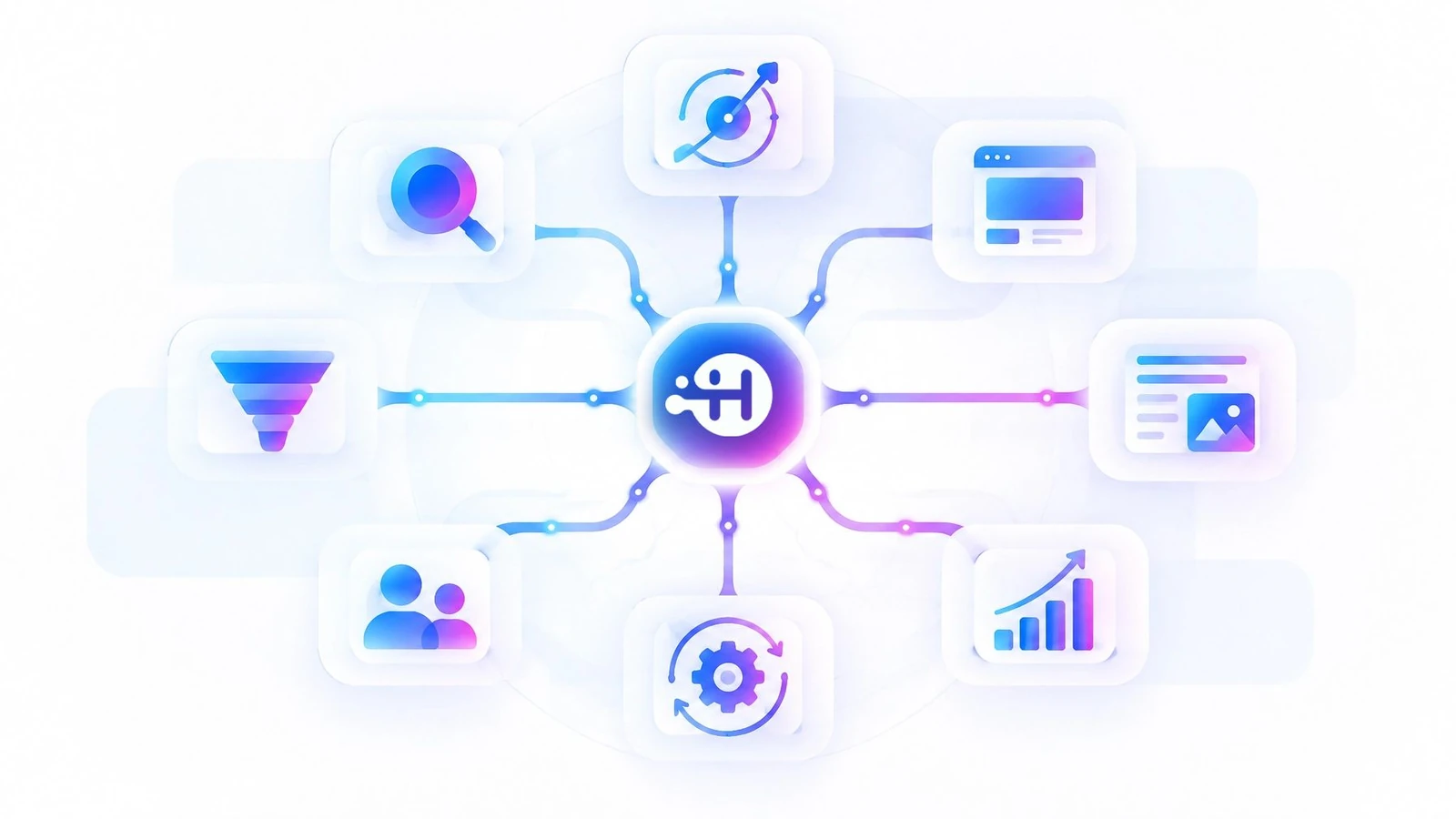



A full service marketing agency is a single partner that handles the entire scope of a brand’s marketing under one roof, from strategy and website design to SEO, content, paid ads, CRM automation, and ongoing optimization. Instead of hiring separate vendors for each piece, a business works with one accountable team that connects every channel into a unified system. The main advantage is consistency: messaging, design, and data stay aligned across every touchpoint instead of fragmenting between disconnected tools and freelancers.
What does a full service marketing agency actually do?
A full service marketing agency manages the full marketing lifecycle rather than a single tactic. That typically means strategy and positioning, website and funnel builds, SEO and content, email and CRM automation, paid ads, and brand design, all coordinated by one team working from the same plan.
The distinction matters because most businesses don’t fail at marketing because they lack activity. They fail because the pieces don’t talk to each other. A website built by one freelancer, ads run by another agency, and email sequences managed in a tool nobody remembers the login for is a recipe for wasted spend and inconsistent messaging. A full service model removes those seams by design.
Core services usually included
Most full service agencies cover a similar core stack, even if the exact packaging varies:
- Marketing strategy and positioning
- Website and landing page design
- Funnels and conversion optimization
- CRM setup, automation, and list management
- SEO and increasingly, answer engine optimization (AEO) for AI search
- Copywriting and messaging systems
- Email marketing and nurture sequences
- Content and blog production
- Paid ads support across search and social
- Brand design and creative
- Ecommerce builds and hosting infrastructure
Not every business needs all of these at once. What matters is that they’re built by a team working from one strategy, not stitched together after the fact.
Full service agency vs. specialized agency: what’s the real difference?
The real difference is scope of ownership, not quality of work. A specialized agency (an SEO firm, a paid ads shop, a web design studio) focuses deeply on one channel and often does it very well in isolation. A full service agency is accountable for how that channel performs alongside every other piece of the marketing system.
Specialized agencies make sense when a business already has a clear strategy and infrastructure, and simply needs an expert to execute one piece of it well. But most small to mid-sized businesses don’t have that foundation in place yet. They have a website from one era, a CRM nobody trusts, and a patchwork of campaigns that were never designed to reinforce each other.
That’s where the handoff problem shows up. The SEO agency optimizes a page, but the web developer changes the template three months later and undoes it. The ad agency drives traffic, but the landing page wasn’t built to convert it. The email tool sends a sequence that doesn’t match the website’s messaging. Each vendor did their job. The system as a whole still broke.
Do you actually need a full service marketing agency?
You need one if your marketing feels scattered, inconsistent, or hard to measure despite being active on multiple channels. If you’re juggling three or more vendors, none of whom talk to each other, a single integrated partner will almost always outperform the sum of those parts.

Signs it’s time to consolidate:
- You have a website, but it wasn’t built to convert, and no one owns fixing that
- Leads come in but disappear because there’s no CRM or follow-up system
- Your brand messaging sounds different on your site, your ads, and your emails
- You’ve hired freelancers for one-off projects that never connected to a broader plan
- You’re spending on ads or SEO without a clear picture of what’s actually converting
On the other hand, if you already have solid infrastructure and simply need help executing one specific channel, a specialized freelancer or boutique shop for that single task might be the more efficient choice. Full service makes the most sense when the problem is the system itself, not just one missing piece of it.
What size business is a good fit?
Full service agencies serve a wide range, from founders who need a strategic foundation built from scratch to established teams looking for an ongoing growth partner. The right fit depends less on company size and more on how many disconnected pieces are currently in play.
A solo founder launching a first funnel and a multi-offer brand juggling five product lines can both benefit from one connected system. The difference is depth of engagement, not whether the model applies.
How much does a full service marketing agency cost?
Pricing varies widely depending on scope, but full service engagements are typically structured in phases rather than a single flat fee. A common approach is a strategic foundation phase (positioning, planning, infrastructure audit), followed by a build phase (website, funnel, CRM setup), then an ongoing growth partnership for ads, content, and optimization.

This phased structure matters because it prevents businesses from paying for execution before there’s a strategy worth executing. Building a funnel or running ads before positioning and messaging are locked in usually means rebuilding later, at a higher total cost than if the foundation had come first.
Businesses with more complex needs, multiple offers, ecommerce, or custom integrations, typically fall into a higher-touch, custom engagement rather than a standard package. If cost is a primary concern, it’s worth asking any agency exactly what’s included in each phase, and what happens if you only need part of the stack today.
How Holly Acre Media approaches full service marketing
Holly Acre Media is built around the idea that marketing infrastructure should function as one connected system, not a collection of disconnected activities. Rather than treating SEO, websites, CRM, and content as separate line items, the agency aligns strategy, visibility (including AEO for AI-driven search), design, automation, and messaging into a single growth engine for each client.
The engagement path follows a structured progression: a strategic foundation phase to set positioning and direction, a build and implement phase for websites, funnels, and CRM infrastructure, an ongoing growth partnership for continued optimization, and white-glove custom engagements for more complex, multi-offer brands. This foundation-first approach means every campaign builds on what came before it, rather than starting from zero with each new initiative.
That structure is worth understanding in more detail before choosing any agency, full service or otherwise. For a closer look at the specific services involved in building that kind of connected system, from funnels and CRM automation to copywriting systems, it helps to see how each piece is meant to reinforce the others rather than operate on its own.
What to ask before signing with any agency
Before committing to a full service agency, it’s worth getting specific about how the pieces actually connect. Ask who owns the strategy behind the work, not just who executes it. Ask how the website, CRM, and content plan are meant to work together, and what happens if you need to scale one piece without redoing the rest.
It’s also worth asking how success is measured. A trustworthy full service partner should be able to speak to measurable outcomes, not just deliverables completed. If an agency can’t clearly explain how a website, a funnel, and a follow-up sequence reinforce each other, that’s a sign the “full service” label may be more packaging than substance.
If your current setup involves separate vendors for your CRM, your website, and your follow-up sequences, it’s worth understanding how a well-managed CRM connects marketing and sales in the first place before deciding whether consolidation makes sense for your business.
Frequently asked questions
Is a full service marketing agency more expensive than hiring freelancers?
Not necessarily. While the upfront engagement may look larger than a single freelance project, full service pricing accounts for coordination, strategy, and consistency that freelancers working independently typically can’t provide. The cost of rework, from misaligned messaging or a website that doesn’t support the ad campaign driving traffic to it, often exceeds the savings of hiring separately.
Can a full service agency work with an existing website or CRM?
Yes, most full service agencies can audit and build on existing infrastructure rather than starting over. Whether that’s the right approach depends on how much of the current setup is actually functional versus how much needs to be rebuilt to support a connected strategy.
How long does it take to see results from a full service agency?
Timelines vary by scope, but foundation work like strategy and positioning typically comes first, followed by builds like websites and funnels, then ongoing optimization. Businesses starting from scratch should expect the foundation and build phases to take longer than incremental improvements to an already-functioning system.
What’s the difference between a full service agency and an in-house marketing team?
An in-house team offers dedicated internal focus but is limited by the skills and bandwidth of the people hired. A full service agency provides access to a broader range of specialized skills (SEO, design, automation, copy) under one coordinated strategy, often at a lower total cost than building an equivalent internal department.
Do small businesses really need a full service agency, or just a website?
It depends on the goal. A website alone can work if there’s no need for ongoing lead follow-up, content, or paid traffic. But most small businesses eventually need a way to capture and nurture leads beyond the site itself, which is where a connected system, rather than a single asset, starts to matter.