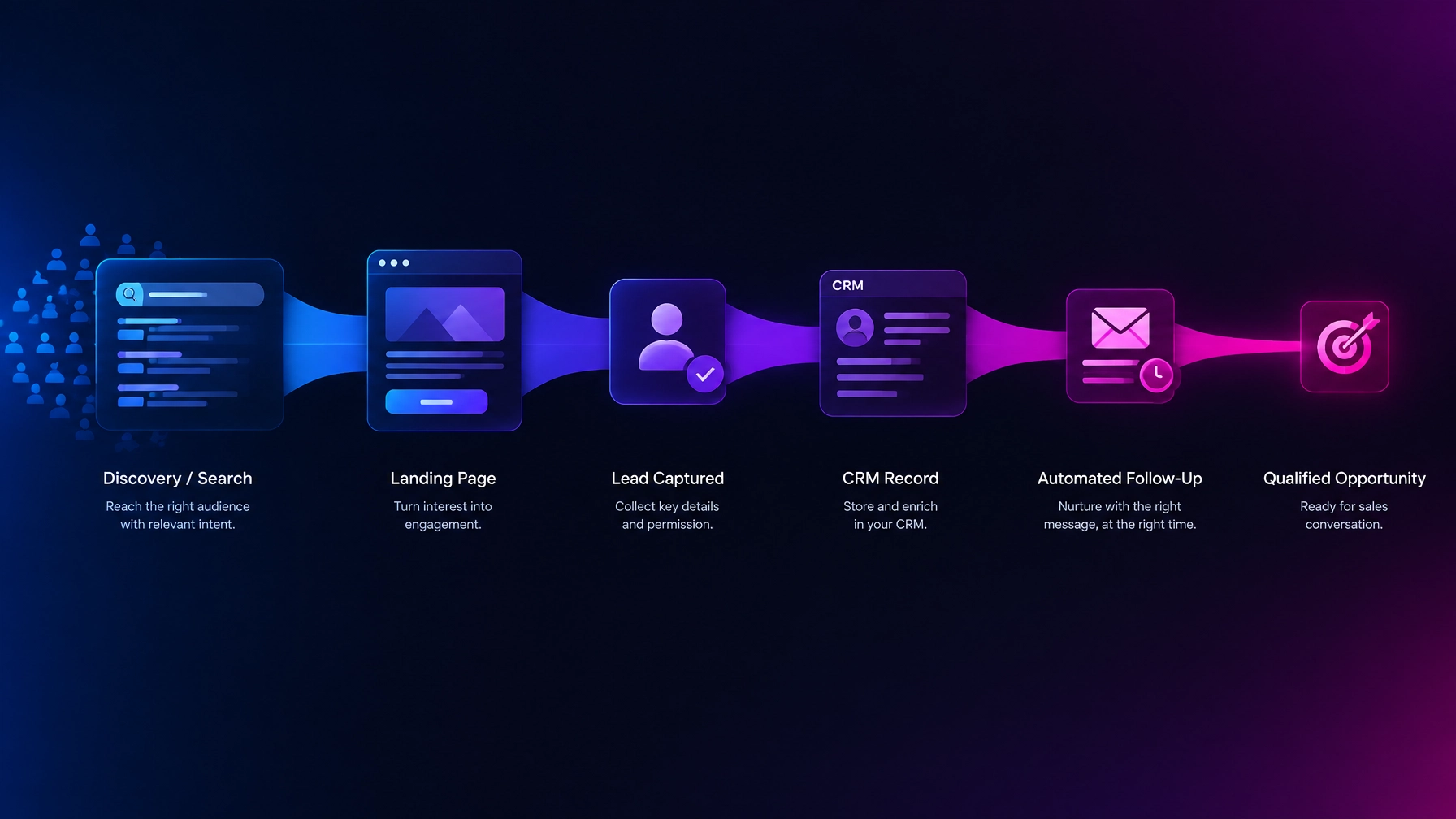



Choosing the right b2b marketing agency is one of the most consequential decisions a growing business will make this year. The right partner brings clarity, structure, and measurable growth. The wrong one adds another disconnected vendor to an already fragmented stack of tools, freelancers, and half-finished strategies. If you’re evaluating options right now, the goal isn’t to find someone who can “do marketing.” It’s to find a partner who can unify everything you’re already doing into one connected growth system.
What Does a B2B Marketing Agency Actually Do?
A b2b marketing agency helps businesses attract, convert, and retain customers through coordinated strategy across channels like SEO, paid media, websites, email, and CRM automation. The best agencies don’t just execute tactics in isolation. They build infrastructure that connects every touchpoint so leads don’t fall through the cracks.
Traditional agencies often specialize narrowly. One handles ads, another handles your website, a freelancer handles copy, and nobody owns the follow-up sequence that actually closes the deal. That fragmentation is exactly what a unified b2b marketing agency is built to eliminate. Instead of five disconnected vendors sending five different invoices and five different opinions, you get one strategic partner accountable for the entire system.
Why Fragmented Marketing Is Costing You More Than You Think
Fragmented marketing quietly drains revenue by creating gaps between your channels where leads get lost, messaging gets inconsistent, and momentum never compounds. Every handoff between vendors is a place where accountability disappears. A prospect clicks your ad, lands on a page that doesn’t match the offer, and never hears from your team again because nobody owns the follow-up.
Business owners often describe this as “a lot of activity, not a lot of results.” You’re running ads, posting on social, maybe even ranking for a few keywords, but nothing feels like it’s compounding. That’s the cost of noise without infrastructure. Less noise. More momentum. That’s the shift a unified agency partnership is designed to create.
The Hidden Tax of Managing Multiple Vendors
Juggling multiple vendors creates a hidden tax in the form of wasted hours, duplicated work, and strategic blind spots that no single vendor is responsible for catching. When your SEO consultant doesn’t talk to your web developer, and your web developer doesn’t talk to whoever manages your CRM, your funnel has cracks in it by design.
This is why more founders and marketing teams are consolidating around a single strategic partner rather than a roster of specialists. It’s not about doing less. It’s about doing it in a way that actually connects.
Key Criteria for Choosing a B2B Marketing Agency
The right b2b marketing agency should be judged on strategic clarity, cross-channel integration, transparent reporting, and a portfolio of real, measurable results, not just creative flair. Here’s what to actually look for during your evaluation.
1. Do They Build Systems, Not Just Campaigns?
A strong agency treats your marketing as an interconnected system rather than a collection of one-off campaigns. Ask how a prospective agency thinks about the relationship between your website, funnels, and CRM automation. If they can’t clearly explain how a lead moves from first click to closed deal, they’re likely thinking in silos, not systems.
2. Can They Explain Their Strategy in Plain Language?
The best agencies can explain complex strategy in language a non-marketer can understand, without hiding behind jargon or vague promises. If every conversation leaves you more confused about what’s actually happening in your account, that’s a red flag, not a sign of sophistication.
3. Do They Own the Full Funnel or Just a Slice of It?
A true growth partner takes ownership of the entire funnel, from visibility and traffic to conversion and follow-up, rather than handing off responsibility at the first sign of friction. This includes everything from high-converting landing pages to the automated sequences that nurture leads after they convert.
4. Is Their Website and CRM Strategy Built for Conversion, Not Just Aesthetics?
A conversion-focused website and CRM setup is judged by how efficiently it turns visitors into booked calls or sales, not by how it looks in a portfolio. Ask to see conversion data, not just design mockups. A beautiful site that doesn’t convert is expensive decoration.
5. What Does Their Reporting Actually Show You?
Transparent reporting should show you exactly which channels are driving revenue, not just vanity metrics like impressions or followers. If a monthly report reads like a highlight reel instead of a business scorecard, push for more clarity before signing anything.
Boutique Agency vs. Traditional Agency: What’s the Real Difference?
A boutique agency typically offers closer strategic partnership, faster communication, and more customized strategy, while traditional or large agencies often rely on templated playbooks and account managers several layers removed from the actual work. Neither model is automatically better, but for founders who want a hands-on strategic partner rather than a rotating cast of junior staff, boutique tends to win on responsiveness and accountability.
The tradeoff is scale. A boutique agency can’t run a Fortune 500’s global ad spend the same way a large network can. But for small to mid-sized businesses, that’s rarely the requirement. What’s needed is clarity, structure, and someone who actually picks up the phone when strategy needs to shift.
Signs You’re Ready for a White-Glove Growth Partnership
You’re ready for a more custom, white-glove engagement when your offers are complex, your funnel spans multiple products or audiences, and templated solutions no longer fit your business. At this stage, generic funnel templates and one-size-fits-all website builds start creating more friction than they solve. A custom-built strategy, tailored to your specific offer stack and customer journey, becomes the more efficient path forward, even if the entry price is higher.
How Messaging Fits Into the Growth Equation
Messaging is the connective tissue that makes every other marketing investment work harder, because even the best-built funnel fails if the words inside it don’t sound human and build trust. A lot of agencies treat copywriting as an afterthought bolted onto the design process. That’s backwards. The words on your site, in your emails, and inside your ad copy are doing the actual persuading. Everything else is infrastructure to deliver them.
This is part of why unified agencies bundle copywriting alongside funnels, websites, and CRM automation rather than outsourcing it separately. Consistent voice across every channel builds trust faster than any individual tactic can.
Where SEO and Visibility Fit Into a Unified Strategy
SEO and visibility strategy work best when integrated with your website and conversion infrastructure, not treated as a standalone service disconnected from the rest of your funnel. Ranking for the right keywords means nothing if the page a visitor lands on doesn’t convert, or if there’s no automated follow-up once they submit a form.
As AI-driven search continues to reshape how buyers find businesses, visibility strategy now extends beyond traditional SEO into how your brand shows up in AI-generated answers. This is increasingly relevant, and it’s worth understanding why answer engine optimization matters for AI search as part of a modern visibility strategy.
Questions to Ask Before You Sign a Contract
Before signing with any b2b marketing agency, ask specifically how they measure success, who owns communication, and what happens if a strategy underperforms in the first 90 days. Vague answers to direct questions are the clearest warning sign available before you’ve spent a dollar.
Other useful questions include how they structure onboarding, whether your CRM and automation setup is included or billed separately, and how quickly they typically see measurable traction. A confident, experienced partner will have clear, specific answers, not deflection.
Bringing It All Together
Choosing a b2b marketing agency ultimately comes down to whether you want a vendor executing isolated tasks, or a strategic partner building one connected growth system around your business. One connected growth system. One strategic partner. That’s the standard worth holding every prospective agency to, regardless of budget or industry.
If your current setup feels scattered across freelancers, disconnected tools, and inconsistent messaging, it may be time to consolidate around a partner built to unify all of it. You can explore Holly Acre Media’s full range of services or get in touch directly to talk through where your funnel currently has gaps.
Frequently Asked Questions
What size business benefits most from working with a b2b marketing agency?
Businesses ranging from early-stage founders needing a strategic foundation to established teams managing complex, multi-offer brands all benefit, as long as the agency’s engagement model scales to match the complexity of the business. The key is matching the engagement level to your actual stage, not overpaying for enterprise complexity you don’t need yet, or underinvesting in infrastructure you’ve already outgrown.
How much should a small business budget for a b2b marketing agency?
Budgets vary widely depending on scope, but most small to mid-sized businesses should expect to invest in both a strategic foundation (website, funnel, CRM setup) and ongoing management, rather than treating either as a one-time expense. A single foundational build without ongoing optimization rarely sustains momentum past the first few months.
How long does it take to see results from a new marketing agency partnership?
Most businesses start seeing measurable traction within 60 to 90 days, though full compounding growth from SEO and content typically takes longer to mature. Paid channels and conversion optimization tend to show faster signal, while organic visibility builds more gradually over several months.
What’s the difference between hiring a freelancer and hiring a b2b marketing agency?
A freelancer typically handles one specific task or channel, while an agency coordinates strategy across your entire funnel and takes ownership of how those pieces connect. Freelancers can be excellent for narrow, well-defined tasks, but they rarely carry accountability for overall business results the way an integrated agency partnership does.
Should I choose an agency that specializes in my industry?
Industry specialization can help, but strategic and technical competence across funnels, conversion, and messaging typically matters more than niche familiarity alone. A skilled agency will ask thorough discovery questions to understand your specific market rather than relying on a templated playbook borrowed from an unrelated industry.